Spinal canal decompression without implants in Zaporizhzhia
Freeing the nerve or the spinal cord from compression: the bony overgrowth, the thickened ligaments and everything else narrowing the canal are removed. The supporting structures of the spine are preserved and no implants are needed. After the operation the distance a person could walk without stopping comes back.
This is the main operation for spinal stenosis, when walking has shrunk to less than a few hundred metres.
- Duration
- 1–3 hours
- Anaesthesia
- general
- Hospital stay
- 2–7 days
- Recovery
- walking allowed on day one, distance grows over weeks
- Incision
- depends on the scope and the level
- Follow-up
- check-up after 2 weeks
What canal decompression is
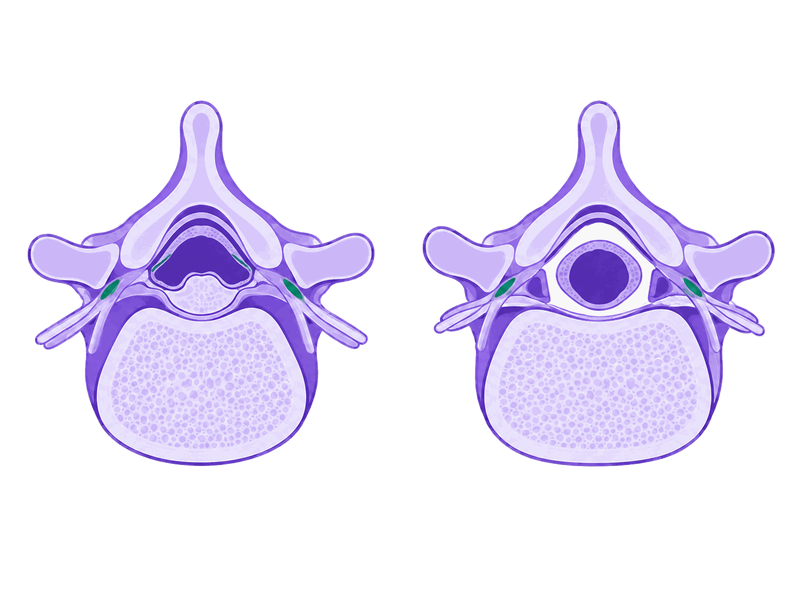
The spinal canal is a bony tunnel carrying the spinal cord and the nerve roots. With age it narrows: the ligaments thicken, bone grows at the edges of the joints, the discs bulge. The nerves run out of room.
The classic complaint in stenosis is easy to recognise: the legs seize up after a hundred or two hundred metres of walking, you have to stop or sit down, and then you can walk the same distance again. Leaning forward or resting on a supermarket trolley helps - because in that position the canal widens slightly.
Decompression removes what narrows the canal, in exactly the amount needed. The aim is to free the nerve while preserving the supporting structures: remove too much and the segment becomes unstable, and then fixation is required.
Who it is for
- Spinal stenosis with a shrinking walking distance: first a kilometre, then a few hundred metres, then as far as the lift.
- Narrowing at the level of a nerve root causing persistent leg pain that treatment does not relieve.
- Weakness in a limb from the compression, especially if it is increasing.
- Spondylodiscitis or tumour involvement compressing the nerve structures.
- Conservative treatment is exhausted while quality of life keeps falling: the person stops leaving the house.
Contraindications
- Active infection outside the operative area.
- Blood clotting disorders that cannot be corrected.
- Severe cardiac and pulmonary insufficiency - assessed by the anaesthetist.
- Marked instability of the segment: decompression alone is not enough, fixation is needed.
A narrowed canal is present in many people after sixty, and on its own it is not grounds for surgery. What we look at is different: how many metres you walk without stopping now, and how many you walked six months ago. A falling number is the argument for operating.
How it goes
- 1 Preparation An MRI of the lumbar spine and, if needed, a CT to assess the bony structures. Blood tests, ECG, examination by a physician and an anaesthetist.
- 2 Anaesthesia General.
- 3 Approach Open or through a minimally invasive port - decided by the scope and the anatomy.
- 4 Main stage The thickened ligaments and bony overgrowth narrowing the canal are removed. The roots are freed and their mobility is checked.
- 5 Stability assessment If a large amount had to be removed and the segment has lost its support, fixation is performed. This is discussed in advance, not after the fact.
- 6 Closing The wound is closed and checked. Getting up is usually allowed on the first day.
Anaesthesia
General anaesthesia. The operation requires complete stillness: the work goes on next to the spinal cord and the nerve roots, where the margin is measured in millimetres.
The risk is set not by age but by the state of the heart, the vessels, the lungs and blood clotting - the anaesthetist assesses this before surgery, from the tests and the ECG. Patients with severe coexisting disease are sometimes offered a smaller operation through a minimally invasive approach. More in the article Anaesthesia for spinal surgery.
Recovery
- day 1
- getting up, walking around the ward
- days 2–7
- hospital stay
- 2 weeks
- check-up, sutures out
- 4–6 weeks
- walking distance grows gradually
- 3 months
- assessment of the final result
Risks and possible complications
- Instability of the segment after removing a significant amount of bone.
- Injury to the dura with leakage of cerebrospinal fluid - repaired during the operation.
- Wound infection.
- Incomplete recovery of sensation if the compression lasted a long time.
- Recurrent narrowing years later: the process that led to the stenosis does not go away.
Alternatives
- Conservative treatment and physical therapy. While the walking distance is stable and the pain is controlled, there is no need to hurry into surgery.
- Nerve block. Relieves a flare-up and helps identify the level, but it does not widen the canal.
- Minimally invasive decompression. Through a port where the anatomy allows: less muscle trauma, a shorter stay.
- Spinal fusion. When decompression alone is not enough and the segment would be left unstable once the canal is widened.
The extent of the operation is decided from the scans: how many levels are narrowed and whether the segment is stable.
Where to start
The scope of the operation is decided from the scans. Bring an MRI of the lumbar spine no more than six months old, a CT if you have one, and discharge summaries from previous treatment. If flexion-extension X-rays were taken, bring those too - they show stability.
Bring the scans on a disc or a flash drive - I look at the images themselves, not the report: what to bring and on what.
I perform the operation in Zaporizhzhia, at the City Hospital of Emergency and Ambulance Care. Call - I will tell you what to do next.
Questions about the operation
Will I be able to walk as I used to?
Walking distance usually increases noticeably - that is the main expected result. By how much depends on how long the nerve was compressed: the longer it was, the slower and less complete the recovery.
Do implants have to be used?
No. If the segment is stable, fixation is not needed. It is added when a lot of supporting bone had to be removed to free the nerve, or when instability was there from the start.
Will the stenosis come back?
The changes that led to the narrowing remain. Years later narrowing can develop at a neighbouring level. That is no reason to postpone surgery: living with a shrinking walking distance while you wait is the worse option.
I am 78 - is surgery worth it?
Age in itself is not a contraindication. What is assessed is the state of the heart, blood vessels and lungs. It is often at this age that the operation gives the most: a person gets back the ability to walk instead of lying down.
Book a visit
Mon-Fri 08:30-15:00. On operating days I cannot answer the phone: message the same number instead.
+380 67 901 37 01Conditions this is used for
Conditions where this method is part of the treatment plan. Each page explains when surgery can be avoided and when it cannot wait.

Dmytro Ivakhnenko - spine neurosurgeon in Zaporizhzhia
Spine neurosurgeon of the highest category, PhD in Medicine, associate professor, 30 years in practice. Spine and nerve surgery in Zaporizhzhia.