Treatment of a disc and vertebral infection in spondylodiscitis in Zaporizhzhia
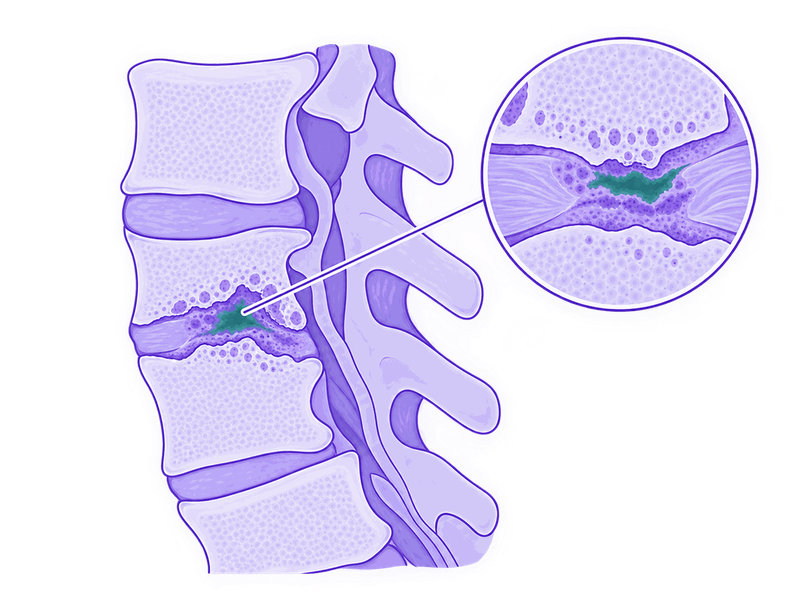
Infection of an intervertebral disc and the neighbouring vertebrae. The back pain is constant, does not ease at rest and wakes you at night; often there is a raised temperature, weakness and sweating, and inflammation shows in the blood tests. It occurs after operations, injections and urological infections, and in people with weakened immunity.
The condition is rare and is almost always found late: the pain is written off as wear and tear while weeks are lost.
- Symptoms
- growing back pain, fever, weakness
- Work-up
- MRI with contrast, blood tests, cultures
- Without surgery
- most cases: prolonged antibiotic therapy
- Surgery
- for nerve compression, instability or failed treatment
- Consultations
- room 211, Mon-Fri 08:30-15:00
- Back pain together with fever - be examined immediately.
- Weakness in the legs, disturbed urination - call 103 (ambulance).
- Pain growing over weeks, independent of position, waking you at night.
- A recent operation, spinal injection, catheter or infection anywhere in the body.
- Sudden weakness, sweating, weight loss alongside the back pain.
This is the condition where an early diagnosis changes everything. Antibiotic therapy started in time avoids surgery; started late, it ends in destroyed vertebrae and neurological complications.
What spondylodiscitis is
An intervertebral disc has a poor blood supply, and an infection that reaches it has an easy time: immune cells struggle to get there. The inflammation destroys the disc, spreads to the neighbouring vertebral bodies, and the segment gradually loses its load-bearing capacity.
The bacteria usually arrive through the bloodstream from another focus - and that can be anything: a tooth, the urinary tract, the skin, the lungs. Less often they come with an operation, a puncture or an injection into the spine. In some patients the source is never found.
The typical late-diagnosis story looks like this: for several weeks the person treats a "pulled back" with ointments and painkillers, the temperature stays low, and only when the pain becomes unbearable or weakness appears in the legs is an MRI done.
Symptoms
- Constant back pain that grows over weeks.
- Pain independent of movement, not relieved by rest, waking you at night.
- Fever - often low-grade, 37–38 °C, which is precisely why it is not taken seriously.
- Sharp tenderness on tapping the spinous process.
- General weakness, sweating, weight loss, poor appetite.
- Restricted movement and a guarded posture.
- With compression of nerve structures - weakness in the legs, numbness, loss of bladder or bowel control.
Causes
Spread of infection through the bloodstream from a distant focus: urinary tract, skin and soft tissue, lung or dental infections, endocarditis.
Direct entry: after spinal surgery, a puncture, an epidural catheter or an injection.
Factors that raise the risk: diabetes, immunodeficiency, immunosuppressive drugs, cancer, haemodialysis, intravenous drug use, older age.
A separate form is tuberculous spondylitis, which runs a slower course and requires different treatment.
How we diagnose it
MRI with contrast is the main investigation. It shows inflammation in the disc and the vertebral bodies earlier than any other method. In the early stage an X-ray shows nothing, and the diagnosis cannot be ruled out on its basis.
Blood tests: ESR, C-reactive protein, full blood count. They are not specific, but they reflect the activity of the inflammation and allow the effect of treatment to be tracked.
Blood cultures and, where possible, a biopsy of the focus with culture. This is the key point: without identifying the organism, antibiotic therapy is given blind. Where possible the sample is taken before antibiotics are started.
A CT assesses the destruction of bone and the stability of the segment.
The contrast MRI, recent blood tests and culture results if they were taken. Be sure to say whether you have taken antibiotics and which ones: that changes how the results are read.
Bring the scans on a disc or a flash drive - I look at the images themselves, not the report: what to bring and on what.
Consultations in Zaporizhzhia, room 211. Be sure to bring the blood tests and any culture results.
How we treat it
The main treatment is not surgical, and that is important to understand from the start.
Antibiotic therapy
Immobilisation
Decompression
Stabilisation
Indications for surgery
- Compression of the spinal cord or the roots with a neurological deficit.
- An epidural abscess.
- Instability of the segment from destroyed vertebrae.
- No response to antibiotic therapy.
- The need to obtain material for culture when a percutaneous attempt failed.
The extent depends on what exactly is preventing recovery: with compressed nerve structures it is decompression, with destroyed vertebrae stabilisation with implants. Surgery does not replace antibiotic therapy; it supplements it.
Treatment is long: antibiotic therapy takes from six weeks to several months, and throughout it blood tests and repeat MRI scans are needed.
The pain begins to ease in the first weeks of correct therapy. Full restoration of the segment's load-bearing capacity takes months; sometimes the vertebrae fuse together, and that is a normal outcome.
Neurological deficits, if they had time to develop, recover better the sooner the compression was relieved.
Questions
Where did the infection come from if I was not ill?
The source often stays unknown. The infection could have come from a tooth, the urinary tract or the skin - sometimes the episode was so mild that it went unnoticed.
Can surgery be avoided?
In most cases yes. The main treatment is antibiotic therapy; surgery is needed for nerve compression, an abscess or instability.
Why take antibiotics for so long?
The disc has a poor blood supply and it is hard to reach the needed drug concentration there. A short course leads to relapse. Treatment must not be stopped at the first sign of improvement.
Is it contagious?
No. The infection is inside the body and is not passed to other people.
Why was the diagnosis made so late?
Because at first the back pain looks ordinary and the temperature is often low. At an early stage only an MRI makes the diagnosis, and for back pain an MRI is not done straight away. That is exactly why back pain together with fever is a reason to be examined immediately.
Call me and I will tell you what to do next
Mon-Fri 08:30-15:00. On operating days I cannot answer the phone: message the same number instead.
+380 67 901 37 01How it is treated
Procedures used for this condition. Each page covers how it goes, who it suits and how long recovery takes.

Dmytro Ivakhnenko - spine neurosurgeon in Zaporizhzhia
Spine neurosurgeon of the highest category, PhD in Medicine, associate professor, 30 years in practice. Spine and nerve surgery in Zaporizhzhia.