Treatment of spinal canal stenosis in Zaporizhzhia
The spinal canal narrows and the nerves run out of room. The complaint is recognisable: the legs "seize up" and go numb after one or two hundred metres of walking, you have to stop or sit down, and after a pause you can walk the same distance again. Bending forward and sitting help; standing and walking make it worse.
This is not an inevitable part of ageing: stenosis can be treated, and afterwards you walk a normal distance again without stopping.
- Symptoms
- the legs go numb and weak when walking, you have to stop
- Work-up
- MRI of the lumbar spine, CT if needed
- Without surgery
- while the distance is stable and the pain is controlled
- Surgery
- canal decompression, 2–7 days in hospital
- Consultations
- room 211, Mon-Fri 08:30-15:00
- Disturbed urination or bowel control, numbness in the groin - call 103 (ambulance).
- Walking distance is shrinking fast - two hundred metres has become fifty within a few weeks.
- Weakness has appeared in the leg, the foot gives way.
- Numbness in both legs, and increasing.
Stenosis usually develops over years, and that is its trap: a person adapts and does not notice their world shrinking to the four walls of their flat. Rapid deterioration is a different matter - there, waiting is not an option.
What spinal canal stenosis is
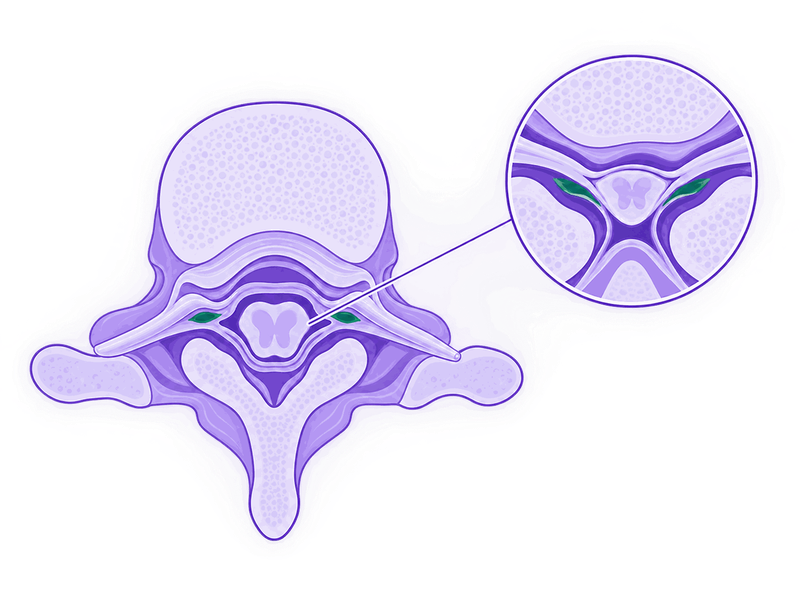
The spinal canal is a bony tunnel carrying the nerve structures. With age it narrows: the ligaments thicken, bone grows at the edges of the joints, the discs bulge. The space shrinks and the nerves run out of room.
Why the symptoms appear specifically on walking: upright and in extension the canal narrows a little further, while working nerves need more blood and oxygen. The result is what is called neurogenic claudication - the legs grow heavy, numb and weak, and you have to stop.
The detail that identifies stenosis almost unmistakably: leaning forward helps. It is easier to walk leaning on a supermarket trolley, easier to cycle than to walk, and easier to stand bent forward than upright. Leaning forward widens the canal slightly.
Symptoms
- The legs seize up, grow heavy and numb after a certain walking distance.
- You have to stop, sit down or lean forward - a minute or two later you can walk on.
- Leaning forward relieves it, extension makes it worse.
- The walking distance gradually shrinks: five hundred metres has become a hundred.
- Numbness and tingling in both legs, often symmetrical.
- Low back pain may be moderate or absent altogether.
Causes
Stenosis is almost always the result of age-related change, a normal process that in some people goes further. Thickening of the ligamentum flavum, bone growth at the edges of the facet joints, loss of disc height - together they gradually reduce the space in the canal.
Less often the canal is narrow from birth, and then symptoms appear earlier. Spondylolisthesis, the after-effects of injury and previous operations all speed it up.
How we diagnose it
The main test is an MRI of the lumbar spine. It shows the soft structures: the ligaments, the discs, the degree of narrowing and at which level the nerves are crowded.
A CT is added when the bony structures need assessing - overgrowth, the state of the joints, bone density before surgery.
Flexion-extension X-rays are needed if instability is suspected: they decide whether decompression will be enough or fixation will be required.
We separately check the leg arteries: claudication can also be vascular. That same detail about leaning forward helps tell them apart - with a vascular cause, leaning forward brings no relief.
An MRI of the lumbar spine no more than six months old, plus a CT and flexion-extension X-rays if they were taken. At the visit, tell me after how many metres you have to stop: that number matters more than the scan.
Bring the scans on a disc or a flash drive - I look at the images themselves, not the report: what to bring and on what.
I see patients in Zaporizhzhia, room 211. If walking is hard, say so when booking - we will find a time when the department is quieter.
How we treat it
Medication
Physical therapy
Nerve block
Surgery - decompression of the canal
Indications for surgery
- The walking distance is shrinking and it is changing your life.
- Weakness has appeared in the leg.
- Loss of bladder or bowel control - we operate urgently.
- Conservative treatment is exhausted while quality of life keeps falling.
Stenosis is the condition where waiting works against the patient. A nerve compressed for years recovers worse and more slowly.
Walking is allowed on the first day after the operation, and the hospital stay is usually two to seven days. Walking distance does not grow at once: the nerve takes weeks to recover. Most of the gain comes in the first six to eight weeks, and the final result is judged at three months.
The longer the nerve was compressed, the slower and less complete the recovery. Pain goes sooner than numbness.
Questions
Why is it easier in a shop with a trolley than just walking?
Because you walk leaning forward, and in that position the canal widens slightly. It is so characteristic of stenosis that the sign has a name of its own.
Can surgery be avoided?
While the walking distance is stable, the pain is controlled and there is no weakness - yes, you can be observed and do physical therapy. That will not widen the canal, but you can live with it for a long time.
I am 78 - can I withstand an operation?
Age in itself is not a contraindication. What is assessed is the state of the heart, blood vessels and lungs. It is often at this age that decompression gives the most: a person gets back the ability to leave the house.
Do implants have to be used?
No. Fixation is needed if the segment is unstable or if a lot of supporting bone had to be removed to free the nerve. With stability intact, decompression is enough.
Will the stenosis come back after surgery?
The process that led to the narrowing remains, and years later narrowing can appear at a neighbouring level. That is no argument for postponing: the years spent with a shrinking walking distance cannot be given back.
Call me and I will tell you what to do next
Mon-Fri 08:30-15:00. On operating days I cannot answer the phone: message the same number instead.
+380 67 901 37 01How it is treated
Procedures used for this condition. Each page covers how it goes, who it suits and how long recovery takes.

Dmytro Ivakhnenko - spine neurosurgeon in Zaporizhzhia
Spine neurosurgeon of the highest category, PhD in Medicine, associate professor, 30 years in practice. Spine and nerve surgery in Zaporizhzhia.