Vertebroplasty and kyphoplasty for a vertebral fracture in Zaporizhzhia
Bone cement is delivered through a needle into the body of the fractured vertebra, strengthening it from within and taking away the pain of micro-movement at the fracture. Kyphoplasty additionally restores the height of the vertebra with a balloon before the cement goes in. There is no incision, the work is done under X-ray guidance, and you can go home the same or the next day.
The method works on fresh fractures: the sooner the better, so with a fresh fracture call at once - we do it in Zaporizhzhia, without sending you to another city.
- Duration
- 40–90 minutes
- Anaesthesia
- local or spinal
- Hospital stay
- 1–3 days
- Recovery
- up by the evening of the same day
- Incision
- none, only a needle puncture
- Follow-up
- X-ray or CT after the procedure, check-up after 2 weeks
What vertebroplasty and kyphoplasty are
In a compression fracture the vertebral body collapses: like a crushed box, it loses height and stops carrying load. In older people this often happens with osteoporosis, sometimes without any fall at all - an awkward movement or lifting a bag is enough. The pain is sharp, worse when changing position, and lets you neither lie nor stand.
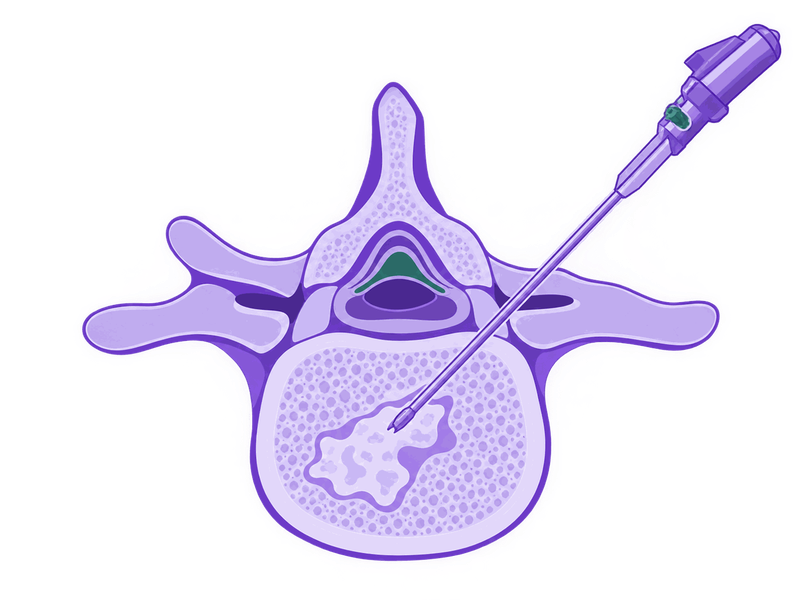
Vertebroplasty solves the problem from the inside. A needle is passed through a puncture into the vertebral body, and bone cement is injected through it, filling the voids and hardening within minutes. The vertebra becomes load-bearing again, and the pain goes along with the micro-movement at the fracture.
Kyphoplasty follows the same principle, but first a balloon is inserted into the vertebra to lift the collapsed endplate and partly restore the lost height. The cavity it leaves is then filled with cement.
Who it is for
- A compression fracture of a vertebra, including an osteoporotic fracture.
- A fresh fracture with severe pain that painkillers do not control and that makes turning over in bed impossible.
- A pathological fracture in tumour involvement of a vertebra - as a pain-relieving and strengthening measure.
- An elderly patient for whom prolonged bed rest is more dangerous than the fracture itself: lying still quickly brings pneumonia, thrombosis and muscle loss.
- A fracture that keeps collapsing on follow-up scans while the pain does not go away for weeks.
Contraindications
- Infection: general, of the skin at the puncture site, or inflammation in the vertebra itself.
- Blood clotting disorders without correction.
- Significant destruction of the posterior wall of the vertebral body - a risk of cement entering the canal.
- Compression of the spinal cord by bone fragments: this calls for decompression, not cement.
- Allergy to the components of the cement.
The method works on fresh fractures. The more time has passed, the smaller the effect: an old fracture fuses in its deformed position, and cement cannot correct that.
How it goes
- 1 Preparation A CT of the fracture area, an MRI to judge how recent it is, and densitometry if there is osteoporosis. Blood tests and an anaesthetist's assessment.
- 2 Position Face down, under local or spinal anaesthesia.
- 3 Puncture Under X-ray guidance the needle is passed through the pedicle into the vertebral body.
- 4 Main stage In kyphoplasty the balloon is inflated first. Then bone cement is injected, with real-time X-ray control.
- 5 Setting The cement hardens within a few minutes. The needle is removed and a dressing applied.
- 6 Right after 3–4 hours of bed rest; you are up by the evening.
Anaesthesia
Local anaesthesia or a spinal block - a general anaesthetic is usually not needed. That is a separate advantage for older patients with heart and lung problems, for whom general anaesthesia is best avoided.
During the procedure you are awake and can say what you feel: working next to a vertebra, that is an extra safeguard. The whole procedure takes about half an hour per vertebra and is done under X-ray guidance, so the position of the needle is visible throughout.
Recovery
- same day
- the pain eases noticeably
- day 1
- getting up and walking allowed
- days 1–3
- discharge home
- 2 weeks
- check-up, we discuss treatment for osteoporosis
- 6 weeks
- return to normal load
Risks and possible complications
- Cement leaking outside the vertebra. Usually without symptoms, but if it reaches the canal it can compress nerve structures - which is why X-ray control is continuous.
- A fracture of the neighbouring vertebra. The strengthened vertebra is stiffer than its neighbours and the load redistributes.
- Infection - very rare.
- Incomplete pain relief, if the pain does not come from that vertebra alone.
Alternatives
- Conservative treatment. A brace, painkillers, reduced load. Suitable for a stable fracture with tolerable pain, but it takes weeks of rest.
- Spinal fusion. For an unstable fracture or destruction of the posterior column, when cement is not enough.
- Decompression. If bone fragments are pressing on nerve structures and weakness in the legs has appeared.
- Treatment of osteoporosis. It does not replace the procedure, but without it the next fracture is a matter of time: we discuss that straight away.
The choice between these depends on how fresh the fracture is, what type it is and how far the vertebral body is destroyed.
Where to start
With a fresh fracture there is no point in waiting: the method works best in the first weeks. Bring a CT of the fracture area, an MRI if one has already been done, discharge summaries and densitometry results if you have them.
Bring the scans on a disc or a flash drive - I look at the images themselves, not the report: what to bring and on what.
I perform vertebroplasty in Zaporizhzhia, at the City Hospital of Emergency and Ambulance Care; consultations are in room 211. Call - I will tell you what to do next and how urgent it is.
Questions about the procedure
Is the cement safe?
Bone cement has been used in orthopaedics for decades, including in joint replacement. It does not dissolve and never needs replacing.
When will the pain go?
Usually within the first day, and in some patients almost immediately after the procedure. That is one of its main strengths: someone who could not turn over in bed starts walking.
How is kyphoplasty better than vertebroplasty?
It partly restores the height of the vertebra and lowers the risk of cement leaking, because the cement goes into a prepared cavity. Which suits you depends on how recent the fracture is and on its shape.
The fracture was six months ago - will it help?
Most likely not: an old fracture has already healed in its deformed position, and cement will change nothing. But it is worth looking at the scans - sometimes the pain comes from a fresh fracture next door that the patient does not know about.
Book a visit
Mon-Fri 08:30-15:00. On operating days I cannot answer the phone: message the same number instead.
+380 67 901 37 01Conditions this is used for
Conditions where this method is part of the treatment plan. Each page explains when surgery can be avoided and when it cannot wait.

Dmytro Ivakhnenko - spine neurosurgeon in Zaporizhzhia
Spine neurosurgeon of the highest category, PhD in Medicine, associate professor, 30 years in practice. Spine and nerve surgery in Zaporizhzhia.