Treatment and removal of spinal tumours in Zaporizhzhia
They are rare but call for a fast answer. What is alarming is pain that does not depend on movement and does not ease at rest, wakes you at night and grows steadily, joined by weakness in the legs, numbness and weight loss. Some spinal tumours are metastases, and then every week matters.
If this pain is what brought you to this page, do not put off the examination - this is dealt with first.
- Symptoms
- pain independent of movement, worse at night, growing over weeks
- Work-up
- MRI with contrast, CT, records of previous investigations
- Without surgery
- the plan depends on the tumour type, decided together with an oncologist
- Surgery
- decompression, stabilisation, biopsy
- Consultations
- room 211, Mon-Fri 08:30-15:00
- Increasing weakness in the legs or arms - call 103 (ambulance).
- Disturbed urination or bowel control - call 103 (ambulance).
- Back pain growing over weeks, unrelated to movement, waking you at night.
- Weight loss, fever, night sweats together with back pain.
- A previous cancer and new back pain - metastases to the spine are more common than primary tumours.
Compression of the spinal cord is an emergency. It is a matter of hours and days: the sooner the pressure is relieved, the better the chance that function returns.
What a spinal tumour is
Tumours in this area fall into three groups, and almost everything depends on which one yours belongs to.
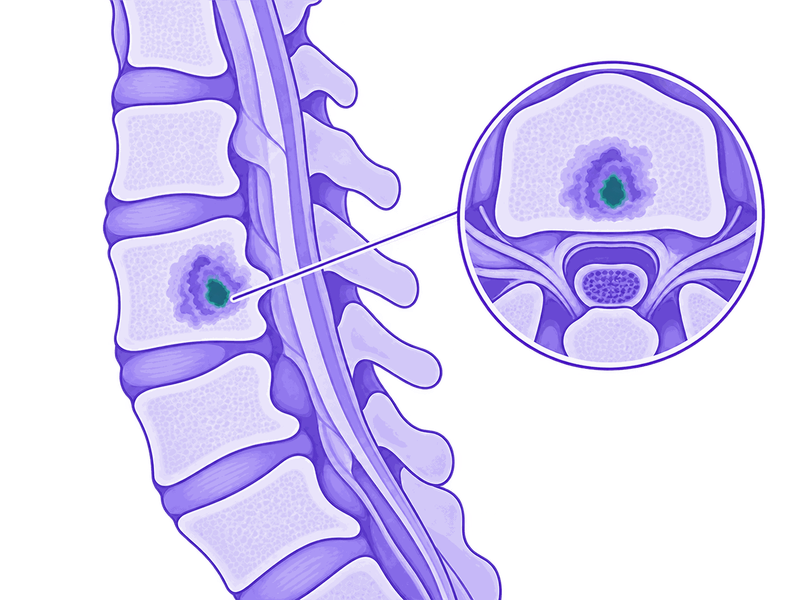
Tumours of the vertebral bodies. Most often these are metastases - spread from another organ. Among primary benign ones the most common is a haemangioma, which usually needs no treatment at all and is found by chance.
Tumours of the spinal cord membranes (meninges). They grow beside the cord and compress it from outside. Most are benign, and after removal the person returns to normal life.
Tumours of the spinal cord itself. The most difficult group; they require special technique.
It is important to understand: the word "tumour" is not the same as "cancer". A large share of findings in the spine are benign, and some need no treatment at all - only observation.
Symptoms
- Back pain unrelated to movement and load - that is its main difference from ordinary pain.
- Pain at night, at rest, waking you and driving you out of bed.
- Pain that grows over weeks and months rather than coming in attacks.
- Increasing weakness in the legs or arms.
- Numbness spreading from below upwards.
- Disturbed urination and bowel control.
- Weight loss, fever, general weakness.
- Sometimes the first sign is a vertebral fracture under minimal load.
Causes
Primary tumours arise from the tissues of the spine itself, its coverings or the spinal cord. In most cases the causes are unknown.
Metastatic disease is the spread of cells from another organ. The spine ranks third for metastases after the lungs and the liver. The most common sources are cancers of the breast, lung, prostate, kidney and thyroid.
Infection stands apart - spondylodiscitis: it looks similar on a scan and requires different treatment.
How we diagnose it
MRI with contrast is the main investigation. It shows the tumour itself, its relationship to the spinal cord and the roots, and the degree of compression. Without contrast the picture is incomplete.
A CT assesses the bony structures: how far the vertebral body is destroyed and whether it still bears load.
A biopsy is needed when the tumour type is unclear. It is done percutaneously under imaging guidance. Without a histological answer treatment cannot be prescribed: the approach differs fundamentally between types.
A search for the primary tumour if metastases are suspected.
All discharge summaries and results of previous investigations, including oncological ones, even if they are years old. The contrast MRI if it has already been done.
Bring the scans on a disc or a flash drive - I look at the images themselves, not the report: what to bring and on what.
Consultations in Zaporizhzhia, room 211 of the City Hospital of Emergency and Ambulance Care. If histology was done at another clinic, bring that too.
How we treat it
Here I do not work alone. The plan is set together with an oncologist and, when needed, with a radiation oncologist and a medical oncologist.
Watchful waiting
Biopsy
Decompression
Removal of the tumour
Stabilisation or vertebroplasty
Radiotherapy and drug treatment
Indications for urgent surgery
- Increasing weakness in the limbs.
- Loss of bladder or bowel control.
- A pathological fracture with instability.
- Uncontrollable pain from a destroyed vertebra.
It depends on the extent of the operation and the starting condition. After decompression the pain usually eases quickly; neurological deficits recover better the sooner the compression was relieved.
With metastatic disease the aim of the surgical stage is often not cure but giving the person back the ability to walk and taking away the pain. That is a full and worthy aim, and it deserves to be discussed openly.
Questions
Is a spinal tumour always cancer?
No. A large share of findings are benign, and some, such as haemangiomas, need no treatment at all. The type is determined from a contrast MRI and, if needed, a biopsy.
They found a haemangioma - what should I do?
Most often nothing beyond observation. Haemangiomas are found incidentally in many people, and the vast majority never cause symptoms. Treatment is discussed when one is large, when the vertebra is being destroyed, or when there is pain.
I had cancer and now my back hurts. Is it metastases?
Not necessarily, but it must be checked, and quickly. Bring all the records of the primary disease and have a contrast MRI done.
Can the tumour be removed completely?
Benign meningeal and nerve-sheath tumours - often yes. With metastatic disease the task is usually different: relieve the compression, restore load-bearing, take away the pain, while the oncologist runs the systemic treatment.
How long can the work-up wait?
Do not wait. With this group of symptoms, time directly affects whether function will return. Call, and I will tell you what to do first.
Call me and I will tell you what to do next
Mon-Fri 08:30-15:00. On operating days I cannot answer the phone: message the same number instead.
+380 67 901 37 01How it is treated
Procedures used for this condition. Each page covers how it goes, who it suits and how long recovery takes.

Dmytro Ivakhnenko - spine neurosurgeon in Zaporizhzhia
Spine neurosurgeon of the highest category, PhD in Medicine, associate professor, 30 years in practice. Spine and nerve surgery in Zaporizhzhia.