Removal of a herniated disc under the microscope in Zaporizhzhia
Removal of the part of the disc that presses on the nerve root. The incision is about two centimetres and I work under an operating microscope: the muscles are parted rather than cut, the bony structures are preserved and the disc itself stays in place - only the escaped fragment is taken out. One to three days in hospital, and you can get up the same day.
This is the main operation for a herniated disc with pain in the leg or the arm when conservative treatment has not worked.
- Duration
- about an hour
- Anaesthesia
- general
- Hospital stay
- about 3 days
- Recovery
- office work usually after a week, full load after 6 weeks
- Incision
- about 2 cm
- Follow-up
- check-up after 2 weeks, MRI after 6 months
What microdiscectomy is
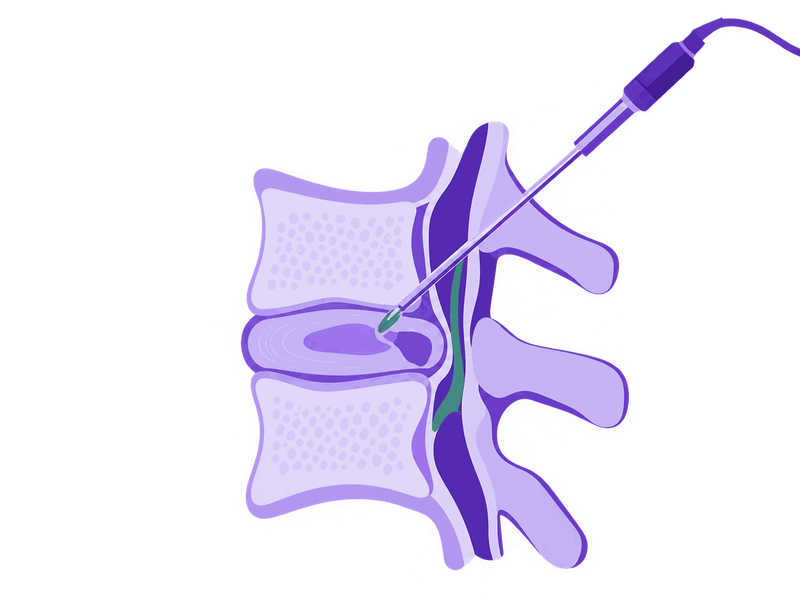
Between the vertebrae lie discs - dense cushions that absorb load when you walk and bend. When the outer ring of a disc tears, the inner part pushes out and presses against the nerve root running to the leg or arm. Hence the pain that shoots below the knee or down to the fingers, the numbness and the weakness.
Microdiscectomy removes exactly that prolapsed fragment, not the whole disc. The vertebra stays where it is, nothing is fixed with implants, and the segment keeps its mobility. The operation is done under a microscope: magnification makes it possible to see the root and work beside it without touching it.
Who it is for
- Pain in the leg or the arm that has not settled in more than six weeks of proper treatment.
- Weakness in the foot or the hand, especially if it is increasing: standing on tiptoe is hard, the foot gives way, the grip weakens.
- Numbness that is spreading in area or no longer clears after rest.
- A herniation on the MRI that matches where it hurts. This matters: a finding on a scan without matching symptoms is no reason to operate.
- Repeated flare-ups that knock you out of work several times a year.
- Disturbed bladder function or numbness in the groin - that is grounds for urgent surgery, not for observation.
Contraindications
- Acute infectious disease and an active inflammatory process.
- Uncontrolled diabetes.
- Blood clotting disorders that cannot be corrected.
- Severe cardiac and pulmonary insufficiency - assessed by the anaesthetist.
- Skin infection at the planned incision site.
Most herniations do not need surgery: the pain subsides within four to six weeks on medication, adjusted loads and physical therapy, and some herniations shrink on their own. The exception is increasing weakness in a limb and disturbed bladder function - there is no waiting there.
How it goes
- 1 Preparation Blood tests, ECG, examination by a physician and an anaesthetist. A light supper the evening before, nothing to eat in the morning. More in the article Preparation for surgery.
- 2 Anaesthesia General. You fall asleep before it starts and wake up when everything is done.
- 3 Approach An incision about two centimetres long over the relevant level. The muscles are parted bluntly rather than cut - that is why it hurts less afterwards than with the classic approach.
- 4 Main stage Under the microscope the root is moved aside and the disc fragment that compressed it is removed. The root is then checked to be free.
- 5 Closing The wound is closed with a cosmetic suture. The whole operation takes one to two hours.
- 6 Right after A few hours in the recovery room, then back to the ward. Getting up is usually allowed the same day or the next morning.
Anaesthesia
Microdiscectomy is done under general anaesthesia: the work goes on next to a nerve root and complete stillness is required.
Anaesthesia frightens many people more than the operation itself, especially patients over sixty. The risk is determined not by age but by the state of the heart, blood vessels, lungs and blood clotting - the anaesthetist assesses this before surgery, from the tests and the ECG. If something needs correcting, the operation is postponed and the numbers are put right first.
In detail in the article Anaesthesia for spinal surgery.
Recovery
- day 1
- getting up, first steps around the ward
- day 3
- discharge home
- 1 week
- office work with limited load on the spine
- 2 weeks
- sutures out, check-up, driving allowed
- 6 weeks
- normal physical activity
- 6 months
- follow-up examination and MRI
Risks and possible complications
Microdiscectomy is a well-established operation with a predictable outcome, but no procedure is entirely without risk. What you should know beforehand:
- Recurrence of the herniation at the same level. It happens in a small proportion of patients. The risk is reduced by respecting the load restrictions in the first weeks, strengthening the core muscles and giving up smoking.
- Scar tissue around the root. It can cause pain months after the operation.
- Injury to the dura with leakage of cerebrospinal fluid - rare, and repaired during the same operation.
- Wound infection. Rare, prevented with an antibiotic.
- Persisting numbness. If the root was compressed for a long time, sensation does not fully return. The pain goes away almost always; the numbness does not.
If leg pain returns after the operation, what is needed is a repeat MRI, not waiting.
Alternatives
- Conservative treatment. The first option in most cases: medication, load management, physical therapy. Six weeks is the standard period in which it becomes clear whether it is working.
- Nerve block. Relieves pain when it is unbearable and surgery is not yet indicated. It also sharpens the diagnosis: it shows whether that level is the source of the pain.
- Nucleoplasty. A percutaneous method for small herniations and protrusions, without an incision.
- Minimally invasive operations. Endoscopic approach where the anatomy justifies it.
Which of these suits you is visible on the scans.
Where to start
What to do, and how much of it, is visible on the scans, not over the phone. Start with a consultation: bring an MRI of the lumbar spine for leg pain or of the cervical spine for arm pain, no more than six months old, discharge summaries from previous treatment and an electronic referral from your family doctor, if you have one. After the examination we will discuss how to proceed in your case.
Bring the scans on a disc or a flash drive - I look at the images themselves, not the report: what to bring and on what.
I operate in Zaporizhzhia, at the City Hospital of Emergency and Ambulance Care; consultations are in the same building, room 211. Call - I will tell you what to do next.
Questions about the operation
Do you remove the whole disc?
No. Only the fragment pressing on the root is removed. The disc stays and keeps working, so the segment keeps its mobility and nothing is fixed with implants.
When will the leg pain go away?
Usually right after the operation: the root is free and what was pressing on it no longer does. Residual sensations in the first days do occur - that is swelling around the root, and it passes. Numbness fades more slowly than pain, sometimes over several months.
Will the herniation come back?
Recurrence at the same level happens in a small proportion of patients. What influences it most is not the operation itself but how you live through the first six weeks: load management, strengthening the back muscles, giving up smoking.
Do I need a brace after the operation?
Usually yes, but not for long and not around the clock - I will give you the exact period at discharge. Wearing a brace for a long time weakens your own back muscles, so it is worn under load, not all day.
How soon can I drive?
Usually after two weeks, provided you are not taking painkillers that affect your reactions and can turn your body freely. Keep the first trips short.
Is microdiscectomy done in the cervical spine?
Yes, the principle is the same but the approach and technique differ. What suits your case is decided from the cervical spine scans.
Book a visit
Mon-Fri 08:30-15:00. On operating days I cannot answer the phone: message the same number instead.
+380 67 901 37 01Conditions this is used for
Conditions where this method is part of the treatment plan. Each page explains when surgery can be avoided and when it cannot wait.

Dmytro Ivakhnenko - spine neurosurgeon in Zaporizhzhia
Spine neurosurgeon of the highest category, PhD in Medicine, associate professor, 30 years in practice. Spine and nerve surgery in Zaporizhzhia.