Treatment of chronic back pain in Zaporizhzhia - radiofrequency ablation
Percutaneous treatment of chronic spinal pain: controlled heating of tissue through a thin electrode placed under X-ray guidance. The principle is the same as in denervation, but the method is used more widely - for different sources of persistent pain, including after previous operations.
It is used when open surgery is not needed while medication and physical therapy give only short-lived relief.
- Duration
- 20–60 minutes, depending on the number of points
- Anaesthesia
- local
- Hospital stay
- home the same day
- Restrictions
- almost none; heavy loads after 1–2 weeks
- Incision
- none, only a needle puncture
- Follow-up
- check-up after a month
What radiofrequency ablation is
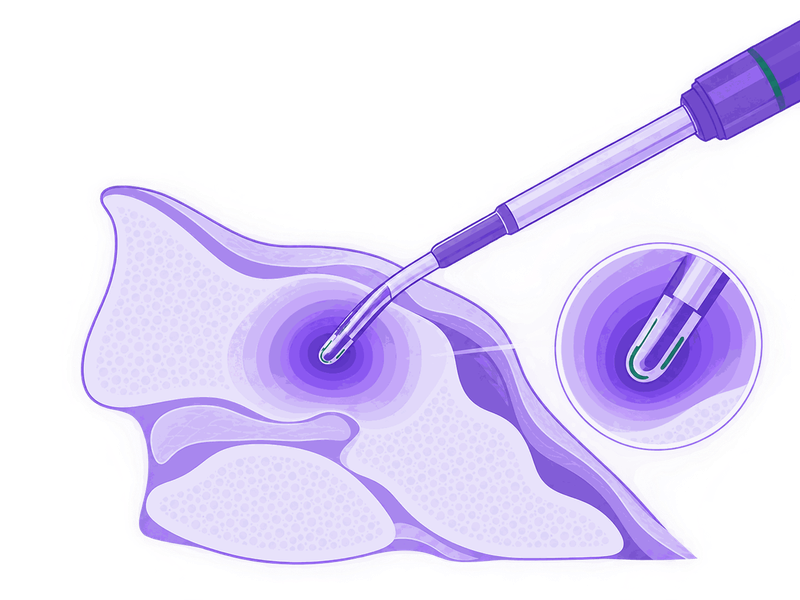
A fine electrode is guided through a puncture to the source of the pain. A radiofrequency field at its tip heats the tissue locally to the required temperature - enough to interrupt the transmission of the pain signal. The treated zone is measured in millimetres and monitored by X-ray.
The key difference from medication: a drug acts on the whole body and stops working once it is cleared, while ablation works at a single point and lasts for months. The key difference from surgery: nothing is removed and nothing is fixed, and the supporting structures of the spine remain untouched.
Who it is for
- Chronic spinal pain when medication and physical therapy give only a short-lived effect.
- Pain whose source has been confirmed by a diagnostic block.
- Patients at high operative risk for whom open surgery is contraindicated.
- Pain returning after a previous denervation.
Contraindications
- Skin infection at the puncture site, general infection.
- Blood clotting disorders without correction.
- An implanted pacemaker - requires separate clearance.
- Pregnancy.
- A neurological deficit requiring decompression: that calls for surgery, not ablation.
How it goes
- 1 Preparation None in particular; come as you would for a routine procedure.
- 2 Position Face down, the skin cleaned with antiseptic, local anaesthesia.
- 3 Targeting The electrode is guided under X-ray and its position checked with test stimulation.
- 4 Treatment Controlled heating for a few tens of seconds at each point.
- 5 After About half an hour of observation, then home.
Anaesthesia
Local anaesthesia only. Your feedback while the electrode is being positioned is part of the safety of the procedure: the sensations show that the electrode is by the right structure and not touching motor fibres.
The skin at the puncture site is numbed separately and the heating feels like warmth. The procedure takes from twenty minutes to an hour depending on the number of points, and you go home the same day.
Recovery
- first day
- normal routine, no heavy loads
- 1 week
- some discomfort at the treated site is possible
- 1–2 weeks
- return to heavy loads
- 2–4 weeks
- the main effect develops
- 1 month
- follow-up visit
Risks and possible complications
- Aching discomfort at the treated site in the first days.
- Temporary numbness of a patch of skin.
- Infection at the puncture site - very rare.
- An insufficient or short-lived effect if the pain has more than one source.
Alternatives
- Nerve block. The diagnostic and first therapeutic step: it shows where the pain comes from.
- Radiofrequency denervation. When the source of the pain is the facet joints of the lumbar or cervical spine.
- Nucleoplasty. When the pain comes from the disc itself and the outer ring is still intact.
- Medication and physical therapy. The baseline treatment of chronic pain, which stays in place after ablation too.
The choice between these methods is made from the scans and the diagnostic block, not from the name of the procedure.
Where to start
Ablation is prescribed on the basis of the examination and a diagnostic block. Start with a consultation: bring an MRI or CT of the relevant part of the spine, no more than six months old, discharge summaries and the records of any earlier blocks.
Bring the scans on a disc or a flash drive - I look at the images themselves, not the report: what to bring and on what.
I perform the procedure in Zaporizhzhia, at the City Hospital of Emergency and Ambulance Care; consultations and bookings are in the same place, room 211. Call - I will tell you what to do next.
Questions about the procedure
How does ablation differ from denervation?
The principle is the same - radiofrequency heating through an electrode. Denervation switches off the nerve of a facet joint specifically, while ablation is the broader name for the method, used for other sources of chronic pain as well. Which one suits is decided from the scans and from the result of the block.
When will it get better?
Not at once. The main effect develops over two to four weeks. In the first days there can even be some discomfort at the treated site - that is normal.
How long does the effect last?
Usually for months, and in some patients for years. The procedure can be repeated.
Will it replace surgery?
Sometimes yes, sometimes no. If a nerve is persistently compressed and weakness is increasing, ablation will not help - decompression is needed. It works where the problem is pain rather than compression.
Book a visit
Mon-Fri 08:30-15:00. On operating days I cannot answer the phone: message the same number instead.
+380 67 901 37 01Conditions this is used for
Conditions where this method is part of the treatment plan. Each page explains when surgery can be avoided and when it cannot wait.

Dmytro Ivakhnenko - spine neurosurgeon in Zaporizhzhia
Spine neurosurgeon of the highest category, PhD in Medicine, associate professor, 30 years in practice. Spine and nerve surgery in Zaporizhzhia.