Recovery and nerve repair after an injury in Zaporizhzhia
After a cut, a fracture or prolonged compression a nerve stops carrying its signal: the hand or the foot will not obey, part of the skin loses sensation, and over time the muscles waste. There is also delayed injury - when the hand "did not come back" after a cast or after surgery on the bone, and it was not noticed at once.
A hard rule applies here: the earlier the operation, the better the result.
- Symptoms
- a muscle that does not work, loss of sensation, burning pain
- Work-up
- nerve conduction study, ultrasound of the nerve, MRI if needed
- Without surgery
- a bruise or compression without rupture recovers on its own
- Surgery
- nerve repair, neurolysis, grafting - microsurgical technique
- Consultations
- room 211, Mon-Fri 08:30-15:00
- A fresh wound after which the hand or foot stops working - that is an indication for surgery within days, not "let us look again in a month".
- After a fracture or a cast the hand no longer extends.
- Increasing burning pain in the area of the damaged nerve.
- No recovery at all three months after the injury.
The main mistake with a nerve injury is waiting. A muscle left without its nerve for too long is replaced by scar and connective tissue, and it cannot be restored afterwards even if the nerve is repaired perfectly.
What a peripheral nerve injury is
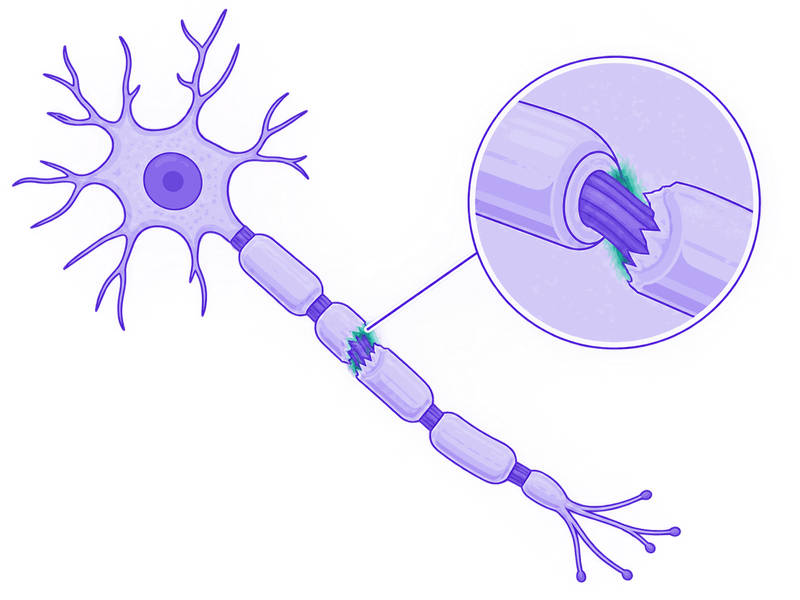
A peripheral nerve is a cable of thousands of fibres in a common sheath. Some fibres carry movement, others sensation.
Damage comes in three degrees of severity. In the mild form only conduction is disturbed and the structure itself is intact - recovery happens on its own within weeks. In the moderate form the fibres are damaged but the sheath is preserved - the nerve regrows at about a millimetre a day. In the severe form the nerve is completely divided, and without surgery the ends will never join correctly.
Hence the arithmetic of recovery: if the nerve is damaged at the shoulder and the hand is what has to work, regrowth takes more than a year. All that time the muscle waits. It can wait about eighteen months - after that it degenerates irreversibly.
Symptoms
- A muscle that does not work: the hand will not extend, the foot drops, a finger will not bend.
- A patch of skin has lost sensation, with fairly sharp borders.
- Burning, shooting pain in the supplied area, sometimes worse than the injury itself.
- Wasting of the muscle over the weeks and months after the damage.
- Dry skin, changes in colour and temperature in the supplied area.
- A jolt on tapping along the nerve - the sign used to track regrowth.
Causes
Cuts and stab wounds - glass, a knife, an industrial accident. Fractures, especially of the humerus and the forearm bones. Dislocations. Compression from a long awkward position or a cast. Traction injuries from a sudden pull on the limb. Iatrogenic injuries during operations and injections.
How we diagnose it
A nerve conduction study is the main investigation. It shows the level and degree of damage and, when repeated, whether recovery is under way. One study describes a state; two spaced apart describe a trend, and it is the trend that determines the plan.
One caveat: immediately after the injury the study tells you little. It becomes informative after about three weeks.
Ultrasound of the nerve shows the anatomy: whether there is a rupture, a neuroma, or compression by scar tissue.
An MRI when damage is suspected in a hard-to-reach area, or a mass is suspected.
The nerve conduction studies - both of them if there were two: the trend matters. The ultrasound of the nerve and a discharge summary describing the injury and any operation.
Bring the scans on a disc or a flash drive - I look at the images themselves, not the report: what to bring and on what.
Consultations in Zaporizhzhia, room 211. With a fresh injury say so when you call: timing matters here and there is no need to wait in the queue.
How we treat it
Traumatic peripheral nerve injuries were the subject of my PhD thesis. I worked separately on how they run their course and are treated in elderly patients.
Observation and rehabilitation
Medication
Neurolysis
Nerve repair
Nerve grafting
Indications for surgery
- A confirmed complete division of the nerve.
- An open wound with loss of function - we operate within days.
- No signs of recovery after three months of observation.
- The nerve is compressed by scar, callus or a mass.
- Increasing neuropathic pain that does not respond to treatment.
For a fresh division that means repair under the microscope; for a gap between the ends, grafting with a donor nerve; for compression by scar, neurolysis. Which one applies is seen from the nerve conduction study and the ultrasound.
A nerve regrows at about a millimetre a day - roughly three centimetres a month. Nothing speeds that up, and the arithmetic has to be respected: the further the injury is from the muscle, the longer the wait.
Sensation returns first, then strength. Rehabilitation is essential throughout: the muscle waiting for its nerve has to stay alive and the joint has to stay mobile.
Full recovery is not always possible. With severe damage the realistic aim is to restore useful function, not a perfect hand. It is more honest to say so before the operation.
Questions
How long should we wait before operating?
It depends on the type of damage. With an open wound and loss of function - days. With a closed injury we observe and repeat the nerve conduction study; if there are no signs of recovery after three months, waiting longer does harm.
Will everything recover completely?
With mild damage, usually yes. With a complete division the result depends on timing, level and age. Sensation returns better than strength.
Two years have passed - is there any point?
For the nerve itself, most likely not: the muscle has already degenerated. But reconstructive options exist - tendon transfers, for instance - that restore function by another route. It is worth looking.
Why does it hurt if the nerve is damaged?
A damaged nerve generates signals of its own and the brain reads them as burning pain. This is neuropathic pain, and ordinary painkillers work poorly on it - different drugs are needed.
Does age matter?
Yes, regeneration is slower in older people. But that is an argument for not delaying surgery, not for refusing it. That is precisely what my thesis was about.
Call me and I will tell you what to do next
Mon-Fri 08:30-15:00. On operating days I cannot answer the phone: message the same number instead.
+380 67 901 37 01How it is treated
Procedures used for this condition. Each page covers how it goes, who it suits and how long recovery takes.

Dmytro Ivakhnenko - spine neurosurgeon in Zaporizhzhia
Spine neurosurgeon of the highest category, PhD in Medicine, associate professor, 30 years in practice. Spine and nerve surgery in Zaporizhzhia.