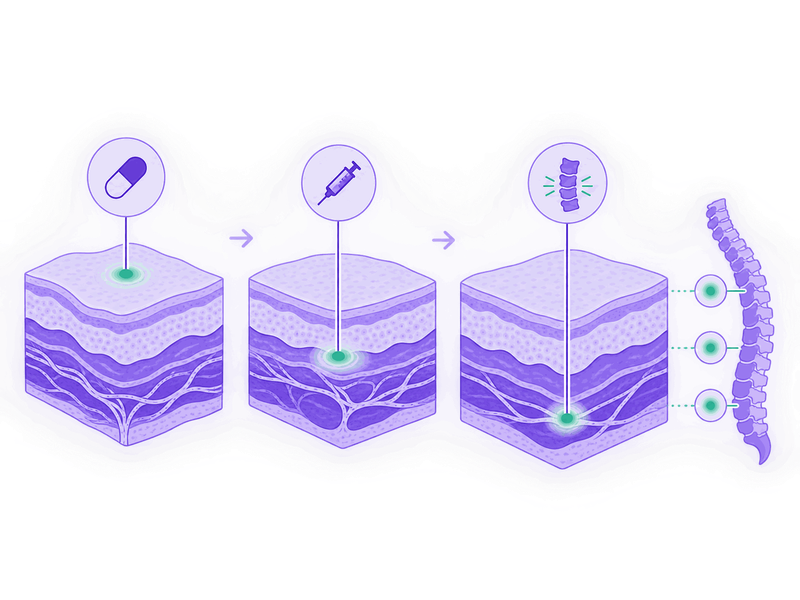
Three kinds of anaesthesia
| Local anaesthesia | Spinal anaesthesia | General anaesthesia | |
|---|---|---|---|
| What you feel | awake, no pain | awake, no feeling in the legs | asleep, feeling nothing |
| When it is used | blocks, denervation, percutaneous techniques | vertebroplasty, some minimally invasive operations | microdiscectomy, decompression, fusion |
| Strain on the body | minimal | small | higher, needs a full assessment |
| Afterwards | home the same day | a few hours lying down | observation in the recovery room |
The choice is made neither by the patient nor by the surgeon alone: it is decided together with the anaesthetist, from the extent of the operation and your condition.
There is a pattern worth knowing: for older patients, methods that avoid general anaesthesia are often preferable. That is exactly why vertebroplasty for a vertebral fracture is done under local or spinal anaesthesia - one of its main strengths.
How it happens
- 1 The anaesthetist's assessment before surgery They review the tests, the ECG and the physician's report, and ask about chronic conditions, past operations, allergies and how you tolerated anaesthesia before. Answer in detail: no detail is too small.
- 2 Choosing the method The anaesthetist explains which kind of anaesthesia is planned and why.
- 3 In the operating room An intravenous line is placed and monitoring is connected: pulse, blood pressure, blood oxygen, ECG. All of it is tracked continuously, from start to finish.
- 4 Going under With general anaesthesia, through the vein - you fall asleep within seconds. With spinal, an injection in the lower back, and within a few minutes the legs lose sensation.
- 5 During the operation The anaesthetist stays beside you the whole time, managing the depth of anaesthesia, the blood pressure and the breathing. That is a separate doctor whose only job is you.
- 6 Waking up You wake in the operating room or in the recovery room, under observation.
What really determines the risk
Not age. What matters is the state of the systems that bear the strain during anaesthesia:
- The heart - a past heart attack, arrhythmia, heart failure.
- The blood vessels - uncontrolled blood pressure.
- The lungs - chronic disease, smoking, asthma.
- Blood clotting - and any drugs that affect it.
- Diabetes - how well it is controlled.
- The kidneys and liver - they clear the drugs.
- Weight - excess weight complicates both the anaesthesia and the recovery.
That is exactly why the anaesthetist insists on a full work-up rather than "just a certificate". If some value is out of range, the operation is postponed and that value is put right first. This is not bureaucracy; this is what managing risk looks like.
What happens after you wake up
- Drowsiness and slowness for the first hours. That is normal and passes.
- A dry mouth and sometimes a sore throat - from the breathing tube. It passes within a day.
- Nausea. It happens; tell the anaesthetist if you get travel sick or felt sick after previous anaesthetics, and different drugs will be chosen.
- Shivering. A common reaction; you will be warmed with a blanket.
- Pain at the operation site. Pain relief is prescribed in advance and there is no need to endure it - tell the nurse.
- After spinal anaesthesia the legs "come back" gradually over a few hours. You may only get up when allowed.
Modern anaesthesia does not cause memory gaps, personality changes or "years taken off your life". Brief forgetfulness and absent-mindedness on the first day does happen in older patients, and it passes.
What next
The list of tests and which medicines are stopped in advance is in Preparing for surgery. The risks of the operation itself and the question of age are in Risks of surgery.
