Treatment of a slipped vertebra in spondylolisthesis in Zaporizhzhia
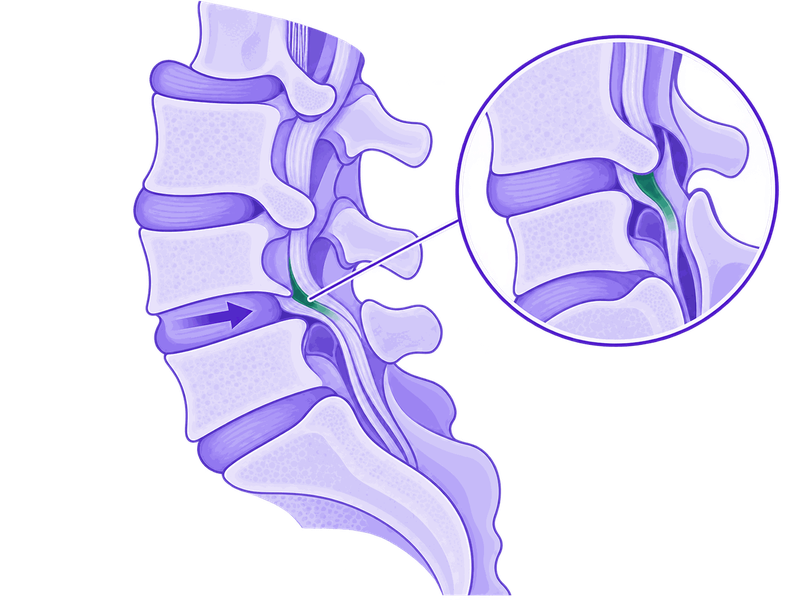
One vertebra slips relative to another and the segment loses its support. It feels like instability in the back: pain when getting up from sitting to standing, a sense that the lower back "will not hold", a constant search for a more comfortable position. The pain may reach the buttock and the thigh and gets worse by evening and after a load.
The decision to operate is made from the symptoms and the mobility of the segment, not from the slip seen on a scan.
- Symptoms
- pain when standing up, a sense of instability, sometimes leg pain
- Work-up
- MRI and flexion-extension X-rays
- Without surgery
- a small slip without nerve compression, held by the core muscles
- Surgery
- spinal fusion, 5–14 days in hospital
- Consultations
- room 211, Mon-Fri 08:30-15:00
- Disturbed urination or bowel control, numbness in the groin - call 103 (ambulance).
- Increasing weakness in the leg, the foot gives way.
- The slip is increasing on repeat imaging.
- A limp has appeared, along with leg pain that was not there before.
What spondylolisthesis is
Normally the vertebrae sit squarely one above another, held by a system of a disc, ligaments and two facet joints. If one of those links stops working, the upper vertebra starts sliding forward over the lower one.
The degree of slip is measured as a percentage of the width of the vertebral body: from grade one, up to twenty-five per cent, to grade four, over seventy-five. Most cases people come with are grades one and two.
What matters here is not the slip itself but stability. If the vertebra has slipped and stays put, the core muscles cope and the nerves are free - people live with that for years and there is nothing to operate on. If the slip increases with movement, the segment is unstable and the nerves suffer, the situation is different.
Symptoms
- Low back pain when rising from sitting to standing - the most recognisable sign.
- A feeling that something "shifts" in the back; a sense of instability.
- Pain worse on extension and on standing for long.
- Leg pain and numbness - if the slip has narrowed the root's exit.
- A limp when walking any distance.
- Sometimes a palpable step along the line of the spinous processes.
Causes
Degenerative spondylolisthesis. The most common form: a worn disc and arthritic facet joints stop holding the vertebra. More often in women after fifty, usually at L4–L5.
Isthmic spondylolisthesis. A defect in the pars interarticularis, often dating from adolescence. It is seen in people who did a lot of gymnastics, weightlifting or wrestling.
Post-traumatic - after a fracture. Iatrogenic - after extensive surgery in which a lot of supporting bone was removed.
How we diagnose it
An MRI of the lumbar spine shows the state of the discs, the degree of canal narrowing and compression of the roots.
Flexion-extension X-rays are the key investigation for this diagnosis specifically. A standard film shows the slip at rest, while a functional one answers the main question: does it change with movement. Whether fixation is needed depends directly on that.
If you have had only an MRI, that is not enough to decide about surgery. The functional films will have to be added.
Flexion-extension X-rays - without them no decision about surgery is made - and an MRI of the lumbar spine. If you have only the MRI, the films will have to be added.
Bring the scans on a disc or a flash drive - I look at the images themselves, not the report: what to bring and on what.
Consultations in Zaporizhzhia, room 211 of the City Hospital of Emergency and Ambulance Care at 80 Peremohy St.
How we treat it
Physical therapy
Medication and activity modification
Nerve block
Spinal fusion
Indications for surgery
- The slip is increasing on repeat imaging.
- Weakness has appeared in the leg and is increasing.
- Persistent leg pain from a compressed root.
- Several months of conservative treatment have brought no result while quality of life is falling.
- Instability is confirmed on functional films.
The slip on a scan is not in itself an indication for surgery. What is operated on is the symptoms, not the picture.
After fusion we get patients up on the first or second day, and the hospital stay is five to fourteen days. Movement becomes noticeably more comfortable within one to two weeks, but full recovery takes three to six months: that is how long the bone block needs to form.
This is the longest rehabilitation of all our operations, and that has to be understood beforehand, not afterwards.
Questions
Can the vertebra be put back?
Partly - during the operation the slip is reduced as far as is safe. But the aim is not a perfect picture; it is to free the nerve and remove the abnormal movement.
Will the slip get worse?
Not necessarily. In many patients it stays stable for decades. That is exactly why with a grade-one slip and no symptoms we observe rather than operate.
Can I do sport?
With a stable slip, yes, with limits: swimming, walking, core strengthening. Avoid axial loading, jumping, weightlifting and sharp extension.
I was told "spinal instability" - is that the same thing?
Close, but not the same. Spondylolisthesis is a displaced vertebra. Instability is excessive movement of a segment, which can exist without a visible slip. A functional film tells them apart.
Do implants have to be used?
If the segment is unstable, yes - otherwise decompression will only worsen the slip. With a stable spondylolisthesis and a compressed nerve, decompression alone is sometimes enough.
Call me and I will tell you what to do next
Mon-Fri 08:30-15:00. On operating days I cannot answer the phone: message the same number instead.
+380 67 901 37 01How it is treated
Procedures used for this condition. Each page covers how it goes, who it suits and how long recovery takes.

Dmytro Ivakhnenko - spine neurosurgeon in Zaporizhzhia
Spine neurosurgeon of the highest category, PhD in Medicine, associate professor, 30 years in practice. Spine and nerve surgery in Zaporizhzhia.