Treatment of a spinal compression fracture in Zaporizhzhia
It happens after a fall or a road accident, and in older age in someone with osteoporosis, sometimes with no fall at all: a sharp movement or a lifted bag is enough. The pain is sharp and grows worse when changing position: turning over in bed, getting up from a chair or into a car is hard. Height may drop and a stoop may appear.
A fresh vertebral fracture is treated better and faster than an old one - here the count is in weeks, not months.
- Symptoms
- sharp back pain, worse when changing position
- Work-up
- CT of the fracture area, MRI to judge how recent it is, densitometry
- Without surgery
- a stable fracture without nerve compression, pain tolerable in a brace
- Surgery
- vertebroplasty or kyphoplasty, 1–3 days in hospital
- Consultations
- room 211, Mon-Fri 08:30-15:00
- Numbness or weakness in the legs after an injury - call 103 (ambulance) and do not move yourself.
- Disturbed urination - call 103 (ambulance).
- The pain lets you neither lie nor stand, and painkillers do not work.
- A fracture after a minor injury or none at all - that signals osteoporosis, and the next fracture will not be long in coming.
- A fracture in someone with a history of cancer.
What a compression fracture is
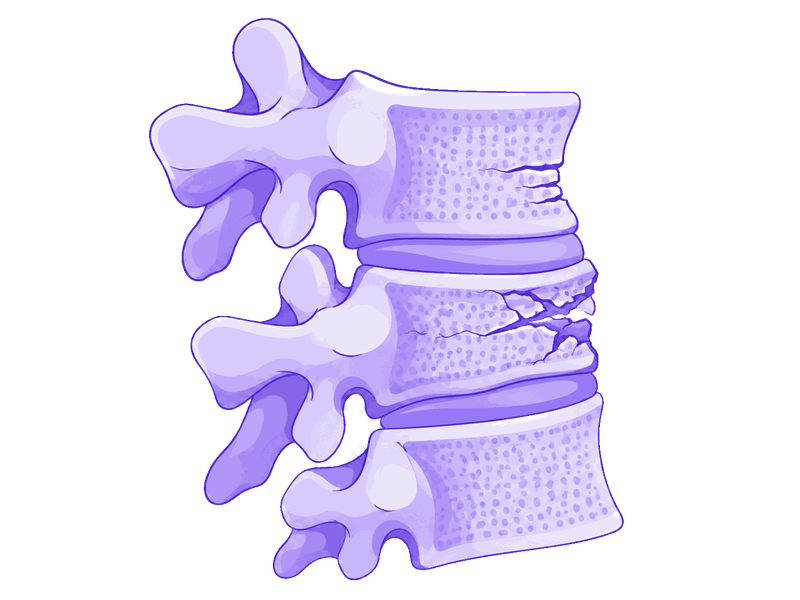
The vertebral body is the supporting block that carries weight. In a compression fracture it collapses: like a box crushed on one side, it loses height and stops carrying load properly.
In young people this takes a serious injury: a fall from height, a traffic accident, a dive into water. In older people far less is enough - sitting down awkwardly, lifting a bag, stumbling on level ground. The reason is osteoporosis: the bone loses density and breaks under a load it used to carry.
One thing matters here: an osteoporotic vertebral fracture is often missed. The person thinks they "just pulled something", treats it with ointments, and six months later a scan shows a vertebra healed in a deformed position. So sudden back pain in an older person is a reason to image, not to medicate.
Symptoms
- Sudden sharp back pain, often traceable to an exact moment.
- Pain worse when moving from lying to sitting to standing, and on coughing or straining.
- Local tenderness on pressing the spinous process.
- Lying still brings relief.
- Over time, loss of height and increasing stoop with multiple fractures.
- Numbness or weakness in the legs - when fragments compress nerve structures.
Causes
Injury: a fall, a traffic accident, a blow, a jump from height.
Osteoporosis: loss of bone density. More often in women after the menopause, in people over sixty-five, with long-term steroid use and with an inactive lifestyle.
A tumour in the vertebra: a pathological fracture through weakened bone. A separate scenario requiring different decisions - see spinal tumours.
How we diagnose it
A CT of the fracture area is the main investigation: it shows the shape of the fracture, how much height has been lost and the state of the posterior wall of the vertebral body. The last of these decides whether cement can be injected safely.
An MRI is needed to tell how recent the fracture is. That is essential: a fresh fracture shows as bone marrow oedema, an old one does not. Vertebroplasty works on fresh fractures, and the MRI answers whether it makes sense.
Densitometry if osteoporosis is suspected. It is not about this fracture; it is about whether there will be another.
A CT of the fracture area and an MRI if one was done: it shows whether the fracture is fresh or old. Plus densitometry results if you have had it, and discharge summaries after the injury.
Bring the scans on a disc or a flash drive - I look at the images themselves, not the report: what to bring and on what.
Consultations in Zaporizhzhia, room 211. With a fresh fracture, call before setting out - I will tell you how best to travel and whether it needs to be today.
How we treat it
Pain relief and a brace
Early mobilisation
Vertebroplasty or kyphoplasty
Stabilisation with implants
Treating the osteoporosis
Indications for surgery
- Painkillers do not control the pain and it prevents standing.
- A fresh fracture - vertebroplasty works best in the first weeks.
- An unstable fracture.
- Compression of nerve structures by fragments - that calls for decompression, not cement.
- An older patient for whom prolonged bed rest is more dangerous than the procedure.
For a fresh stable fracture that means vertebroplasty or kyphoplasty - cement through a needle, no incision. For an unstable fracture or nerve compression, stabilisation with implants is needed, sometimes together with decompression.
After vertebroplasty the pain eases noticeably, usually within the first day; patients are allowed to get up by the evening of the same day, with discharge after one to three days. Return to normal load takes about six weeks.
With conservative treatment it takes longer: several weeks in a brace, then a gradual increase in load under supervision.
A word about osteoporosis: cement solves the problem of one vertebra, not the cause. Without treating the osteoporosis the next fracture is only a matter of time, and that is the most common mistake after a successful procedure.
Questions
The fracture was a month ago - is it too late?
Most likely not, but the MRI decides: it will show whether the fracture is still fresh or has already healed. The sooner, the better the result.
Can a brace be enough?
For a stable fracture with tolerable pain, yes. But in older people it is worth weighing up: several weeks in a brace with restricted movement has its own cost, while vertebroplasty lets you get up the same day.
Why did the fracture happen without a fall?
That is typical of osteoporosis: the bone loses density and breaks under ordinary load. Such a fracture is a reason to have densitometry and start treating the osteoporosis, otherwise there will be more.
Will a hump be visible?
With a single fracture, usually not. With multiple osteoporotic fractures the thoracic spine gradually bends forward and height is lost. Kyphoplasty partly restores the height of the vertebra if it is done in time.
Will the cement have to be replaced later?
No. Bone cement does not dissolve, it stays for good and never needs replacing.
Call me and I will tell you what to do next
Mon-Fri 08:30-15:00. On operating days I cannot answer the phone: message the same number instead.
+380 67 901 37 01How it is treated
Procedures used for this condition. Each page covers how it goes, who it suits and how long recovery takes.

Dmytro Ivakhnenko - spine neurosurgeon in Zaporizhzhia
Spine neurosurgeon of the highest category, PhD in Medicine, associate professor, 30 years in practice. Spine and nerve surgery in Zaporizhzhia.