Minimally invasive spine surgery in Zaporizhzhia
Endoscopic and percutaneous procedures through an incision of a few millimetres. The muscles are not cut, blood loss is minimal, there is less pain afterwards, you get up sooner and the hospital stay is shorter - where the anatomy and the scans justify it.
Minimal invasiveness is not a goal in itself: the method is chosen from the scans, not from a wish for a smaller incision. If the work needed cannot be done with an endoscope, an open operation is performed.
- Duration
- 1–3 hours
- Anaesthesia
- general or spinal
- Hospital stay
- 1–5 days
- Recovery
- early mobilisation, light work usually within a week
- Access
- from a few millimetres
- Follow-up
- check-up after 2 weeks
What minimally invasive spine surgery is
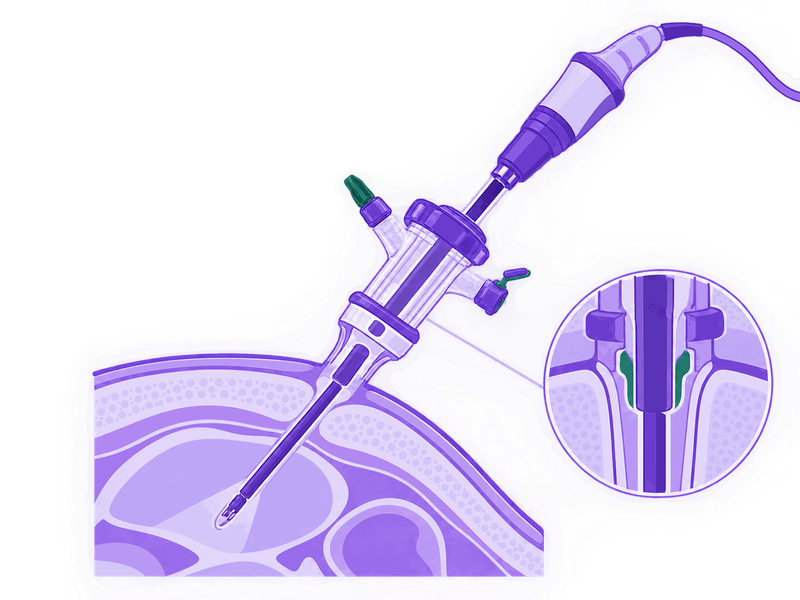
A classic spine operation needs a surgical approach through which the surgeon sees the field with their own eyes. A minimally invasive one works differently: an endoscope with a camera and the instruments go in through a port a few millimetres across, and the image is shown on a screen at high magnification.
What that gives the patient: the muscles are barely injured, blood loss is minimal, there is less pain afterwards, you can get up sooner and the hospital stay is shorter. What it does not change: the indications. If the scans call for work that cannot be done endoscopically, an open operation is performed, and that is the right decision, not a retreat.
Minimally invasive procedures include endoscopic removal of a herniated disc, decompression of the canal through a port, surgery for carpal tunnel syndrome and a number of percutaneous techniques.
Who it is for
- Herniations and stenosis in a suitable location - decided from the MRI.
- Carpal tunnel syndrome and other compression neuropathies.
- Patients at high surgical risk, for whom shortening anaesthesia time and blood loss matters.
- Peripheral nerve tumours and nerve injuries, where microsurgical technique is needed.
- Working people who need to return to their usual load sooner: a shorter stay and a gentler recovery.
Contraindications
- Active infection.
- Blood clotting disorders without correction.
- Anatomy in which the required work cannot be done through a small incision - then an open operation.
- Marked instability of the segment: fixation is needed, not decompression alone.
A small incision is good where the work needed is precise and limited: one level, preserved anatomy, no scarring from earlier surgery. Without those conditions an endoscope will not do the job - and the right decision is an open operation.
How it goes
- 1 Preparation Standard: blood tests, ECG, examination by a physician and an anaesthetist.
- 2 Anaesthesia General or spinal, depending on the level and the scope.
- 3 Approach A working port is placed through a puncture, its position checked by X-ray.
- 4 Main stage Work under magnification: the herniation is removed, the structures compressing the nerve are cleared away, the root is freed.
- 5 Closing The port is removed and one or two sutures are placed.
- 6 Right after Getting up is usually allowed on the first day.
Anaesthesia
It depends on the procedure: for some, local anaesthesia is enough; others need a spinal block or a general anaesthetic. For patients with heart and lung disease, being able to avoid general anaesthesia is one of the main advantages of the method.
Which option suits you is decided with the anaesthetist before surgery, from the tests, the ECG and any co-existing conditions. More in the article Anaesthesia for spinal surgery.
Recovery
- day 1
- getting up, walking around the ward
- days 1–5
- hospital stay
- 1 week
- light work
- 2 weeks
- check-up, sutures out
- 6 weeks
- full load
Risks and possible complications
- Conversion to an open operation during the procedure if the task cannot be completed through the port. That is not a complication but a planned fallback.
- Incomplete removal or recurrence - the risk is higher with poor patient selection, which is why selection is based on the scans.
- Injury to a nerve root - rare.
- Infection - rare.
Alternatives
- Microdiscectomy. Open microsurgical approach where it is justified: full view and the freedom to remove any fragment.
- Nucleoplasty. A percutaneous method for small herniations, with no incision at all.
- Canal decompression. For stenosis, when the narrowing runs over several levels.
- Nerve block. When surgery is not yet indicated but the pain has to be dealt with now.
A minimally invasive approach is a way of doing the same work with less trauma, not a separate kind of treatment: the grounds for operating stay the same.
Where to start
Whether a minimally invasive approach suits you is visible on the MRI: what matters is the position of the herniation, the state of the bony structures and the stability of the segment. Bring scans of the relevant part of the spine, no more than six months old, and your discharge summaries.
Bring the scans on a disc or a flash drive - I look at the images themselves, not the report: what to bring and on what.
I operate in Zaporizhzhia, at the City Hospital of Emergency and Ambulance Care; consultations are in room 211. Call - I will tell you what to do next.
Questions about the operation
Is minimally invasive surgery always better?
No. It is better where the anatomy allows it. If the work needed cannot be done through a port, a small incision turns into an incomplete operation and a second procedure.
How much less does it hurt afterwards?
Noticeably less: the muscles are not cut. But this is an operation, not a procedure, and there will be discomfort in the first days.
Will there be a scar?
One or two punctures about a centimetre long. Over time they become almost invisible.
Can this be done in old age?
In old age it is often exactly what is preferable: shorter anaesthesia, less blood loss, earlier mobilisation. What decides is not age but the state of the heart, lungs and blood vessels.
Book a visit
Mon-Fri 08:30-15:00. On operating days I cannot answer the phone: message the same number instead.
+380 67 901 37 01Conditions this is used for
Conditions where this method is part of the treatment plan. Each page explains when surgery can be avoided and when it cannot wait.

Dmytro Ivakhnenko - spine neurosurgeon in Zaporizhzhia
Spine neurosurgeon of the highest category, PhD in Medicine, associate professor, 30 years in practice. Spine and nerve surgery in Zaporizhzhia.