Removal of a herniated disc without an incision in Zaporizhzhia
A percutaneous method for small herniations and protrusions. Part of the nucleus is removed through a needle inside the disc, the pressure inside drops and the bulge draws back and stops pressing on the nerve root. There is no incision, no general anaesthesia, and you go home the day of the procedure.
The method has limits: it works while the outer ring of the disc is intact. With a large herniation or a sequestrated fragment it is useless, and the scans show that in advance.
- Duration
- 30–60 minutes
- Anaesthesia
- local
- Hospital stay
- same day or one night
- Recovery
- light work after a few days, the effect builds over 4–6 weeks
- Incision
- none, only a needle puncture
- Follow-up
- check-up after a month
What nucleoplasty is
A disc is built like a cushion: a dense outer ring with a gel-like nucleus inside. When the nucleus presses on a weakened ring, the ring bulges towards the canal - that is a protrusion or a small herniation, which can press against a root.
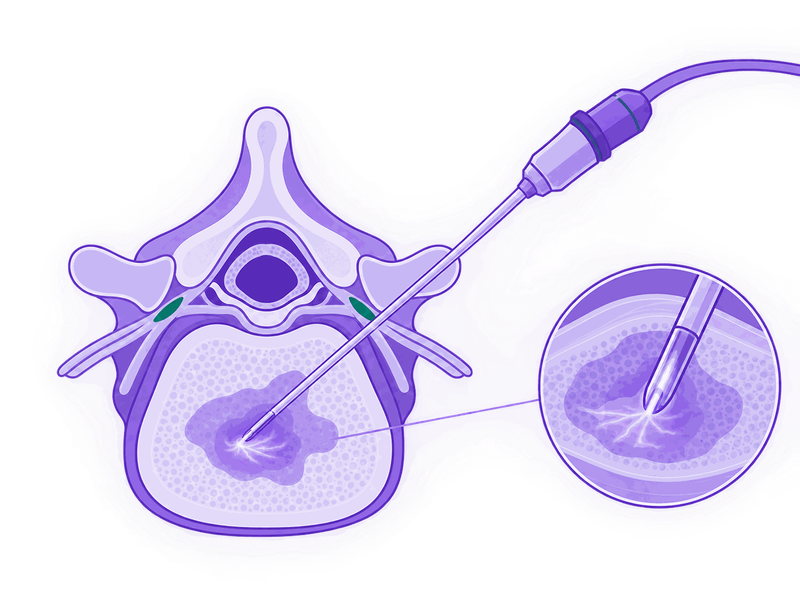
Nucleoplasty works on that internal pressure. A working instrument - cold plasma, a laser or a radiofrequency electrode, depending on the technique - is brought into the nucleus through a needle. A small amount of the nucleus is removed, the pressure inside the disc falls and the bulge shrinks.
The key condition is an intact outer ring. If it is torn and a fragment has already escaped, the method does not work: lowering the pressure inside makes no sense when the contents are outside. That is exactly why selection is made strictly from the MRI.
Who it is for
- A small herniation or protrusion confirmed on MRI, with the outer ring of the disc intact.
- Pain in the lower back or the neck radiating into the leg or the arm and lasting more than six weeks.
- Conservative treatment gave only temporary relief, while there are as yet no grounds for open surgery.
- The height of the disc is preserved: if the disc has collapsed, the method will not work.
- General anaesthesia is undesirable - because of age or the state of the heart and lungs.
Contraindications
- A sequestrated herniation - a free fragment in the canal.
- Significant loss of disc height.
- Spinal canal stenosis and instability of the segment.
- General infection or infection at the puncture site.
- Blood clotting disorders without correction.
Nucleoplasty works while the herniation is small and the ring of the disc is intact. If the fragment has already come out or the disc has collapsed, there is no pressure left to reduce - and then the honest answer is that a microdiscectomy is needed, not a puncture.
How it goes
- 1 Preparation An MRI of the relevant part of the spine and blood tests. No special preparation is needed.
- 2 Position Face down, local anaesthesia.
- 3 Puncture Under X-ray guidance the needle is placed into the disc. Its position is checked in two projections.
- 4 Main stage A small amount of the nucleus is removed through the needle. It takes a few minutes.
- 5 After A period of observation, then home or one night in hospital.
Anaesthesia
Local anaesthesia only. As with other percutaneous techniques, your feedback while the needle is being positioned matters: the sensations show that the needle is going into the disc and not towards the nerve root.
No general anaesthetic is needed, so the method suits patients for whom general anaesthesia is undesirable. The procedure takes about half an hour; you go home the same day and can drive the next.
Recovery
- first day
- rest, no load
- 3–5 days
- light work
- 2 weeks
- normal everyday activity
- 4–6 weeks
- the main effect develops
- 1 month
- follow-up visit
Risks and possible complications
- Insufficient effect - the main risk of the method. It usually comes from poor selection: if the ring was already torn, lowering the pressure is pointless.
- A temporary increase in pain in the first days.
- Discitis - inflammation of the disc. Very rare, but it requires serious treatment.
- Accelerated disc degeneration in the long term.
Alternatives
- Conservative treatment. The first step for a small herniation or protrusion: medication, adjusted loads, physical therapy.
- Nerve block. Relieves a flare-up and clarifies which level is causing the pain.
- Microdiscectomy. When a fragment of the disc has already passed beyond the outer ring - in that situation a percutaneous method is useless.
- Minimally invasive surgery. Endoscopic removal of the herniation where the anatomy allows it.
What suits you is visible on the MRI: the size of the bulge, the state of the outer ring and the height of the disc all matter.
Where to start
Whether this method suits you is decided by the MRI: we need to see the size of the bulge, the state of the outer ring and the height of the disc. Bring scans of the relevant part of the spine, no more than six months old, and your discharge summaries.
Bring the scans on a disc or a flash drive - I look at the images themselves, not the report: what to bring and on what.
I perform the procedure in Zaporizhzhia, in the same place where I see patients - the City Hospital of Emergency and Ambulance Care. Call - I will tell you what to do next.
Questions about the procedure
Will the herniation disappear completely?
No. The method lowers the pressure inside the disc and the bulge draws back only partly. The aim is to take the pressure off the root, not to restore the disc to its original shape.
Why was I refused nucleoplasty?
Most likely because of the scans: a torn outer ring, a sequestrated fragment or reduced disc height. In those cases the method will not work, and it is more honest to say so at once.
Is it done with a laser?
It can be a laser, cold plasma or a radiofrequency electrode - the principle is the same, the instrument differs. Which one is used is decided case by case.
Can it be repeated?
At the same level it is rarely repeated. If there was no effect, that usually means a different method is needed rather than a second attempt with the same one.
Book a visit
Mon-Fri 08:30-15:00. On operating days I cannot answer the phone: message the same number instead.
+380 67 901 37 01Conditions this is used for
Conditions where this method is part of the treatment plan. Each page explains when surgery can be avoided and when it cannot wait.

Dmytro Ivakhnenko - spine neurosurgeon in Zaporizhzhia
Spine neurosurgeon of the highest category, PhD in Medicine, associate professor, 30 years in practice. Spine and nerve surgery in Zaporizhzhia.