Treatment of pain in the spinal joints in Zaporizhzhia - denervation
Through a needle under X-ray guidance the small nerve branches that carry pain from the facet joints are switched off. The joint stays in place, the mobility of the spine is preserved and there is no incision. The effect lasts months, sometimes years, and the procedure can be repeated if needed.
It is used when a nerve block brought relief but not for long - that is the clearest sign denervation will work.
- Duration
- 30–60 minutes
- Anaesthesia
- local
- Hospital stay
- home the same day
- Effect
- develops over 2–4 weeks
- Incision
- none, only a needle puncture
- Follow-up
- check-up after a month
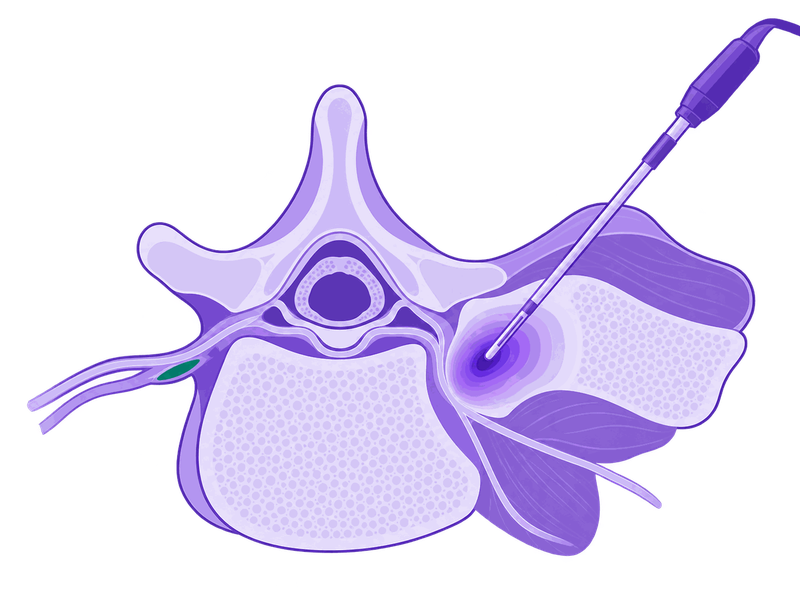
What radiofrequency denervation is
Between the vertebrae there are small joints - the facet joints. With age and load they wear out, and then they become the source of chronic pain in the lower back or the neck. The pain usually does not shoot down the leg: it is local, worse on extension and turning, and in the morning you have to "walk it off".
A thin nerve branch runs to each of those joints and carries nothing but the pain signal. Denervation switches it off with pinpoint heating through an electrode. The joint stays where it is, the mobility of the spine is unchanged, the muscles are unaffected - only the transmission of pain is switched off.
The nerve branch regenerates in time, so the effect is not permanent. It usually lasts several months, in some patients years, and the procedure can be repeated.
Who it is for
- Facet syndrome: local pain on extending and turning the trunk.
- Chronic low back pain lasting for months.
- A diagnostic block gave relief, but only briefly. This is the main selection criterion: denervation is done where a block has already confirmed the source of the pain.
- Surgery is not indicated or is contraindicated for the patient.
Contraindications
- Skin infection at the puncture site, general infection, fever.
- Blood clotting disorders without correction.
- An implanted pacemaker - requires separate assessment and clearance.
- Pregnancy.
How it goes
- 1 Preparation None in particular. Tell us about regular medicines and about a pacemaker if you have one.
- 2 Position Face down, the skin cleaned with antiseptic.
- 3 Targeting A thin electrode is guided to the right point under X-ray. Its position is checked with test stimulation - you say what you feel.
- 4 Treatment The tip of the electrode is heated for a few tens of seconds. Every level that causes pain is treated.
- 5 After About an hour of observation to check how you react to the medication, then home. Back to normal activities the next day.
Anaesthesia
Local anaesthesia only. A general anaesthetic is deliberately not used: while the electrode is being positioned your feedback is needed. I pass a weak current and ask what you feel - that is how it is confirmed that the electrode sits by the pain branch and not by a motor nerve.
The heating itself takes about a minute per point and feels like warmth or a dull, pulling pressure. An hour after the procedure you go home; no special recovery is required.
Recovery
- first day
- normal routine, no heavy loads
- 2–7 days
- some discomfort at the site is possible and normal
- 2–4 weeks
- the main pain-relieving effect develops
- 1 month
- follow-up visit, we assess the result
Risks and possible complications
- Discomfort and aching at the treated site in the first week.
- Temporary numbness of a patch of skin over the treated joint.
- Infection at the puncture site - very rare.
- No effect, or a short-lived one. Possible when the pain does not come from the facet joints alone.
Alternatives
- Nerve block. The first step: it relieves the pain and confirms that the source is indeed the facet joints.
- Radiofrequency ablation. A related method for chronic pain of another location and another origin.
- Physical therapy and strengthening the core. Without it any pain relief is temporary: the load returns to the same joints.
- Microdiscectomy or decompression. If the examination shows the pain comes from a compressed nerve rather than from a joint.
Denervation goes well with exercise: a few months without pain is exactly the window in which the muscles can be built up.
Where to start
Denervation is done on the basis of a diagnostic block, so we start with a consultation and the scans. Bring an MRI or CT of the lumbar spine and the records of any blocks you have had: which ones, when, and with what effect.
Bring the scans on a disc or a flash drive - I look at the images themselves, not the report: what to bring and on what.
I perform denervation in Zaporizhzhia, at the same hospital where I hold consultations - no separate trip to another city is needed. Call - I will tell you what to do next.
Questions about the procedure
Is the nerve switched off for good?
No. The branch regenerates in time and the pain can return. That usually takes from several months to several years. The procedure can be repeated.
Why a block first and denervation after?
A block shows whether the pain really comes from the facet joints. If it brought relief, denervation will work. If it did not, the source is elsewhere and denervation will be useless.
Will numbness remain?
Sometimes a small patch of skin over the treated joint loses sensation. It does not affect movement or strength and usually resolves with time.
Is this an operation?
Formally it is a minimally invasive procedure: no incision, local anaesthesia, home the same day. But it is done in an operating room under X-ray guidance, because here accuracy decides everything.
Book a visit
Mon-Fri 08:30-15:00. On operating days I cannot answer the phone: message the same number instead.
+380 67 901 37 01Conditions this is used for
Conditions where this method is part of the treatment plan. Each page explains when surgery can be avoided and when it cannot wait.

Dmytro Ivakhnenko - spine neurosurgeon in Zaporizhzhia
Spine neurosurgeon of the highest category, PhD in Medicine, associate professor, 30 years in practice. Spine and nerve surgery in Zaporizhzhia.