Stabilisation of vertebrae with implants in Zaporizhzhia - spinal fusion
Fixation of two or more vertebrae with implants when the spine has lost its stability: in spondylolisthesis, after fractures, when a segment is destroyed. Screws and rods take the load while bone fusion forms between the vertebrae. We use implants of Ukrainian and foreign manufacture, certified in Ukraine.
This is major surgery, and it is offered when the spine no longer holds without it. I perform it in Zaporizhzhia, and the implant is chosen before the operation.
- Duration
- 2–6 hours
- Anaesthesia
- general
- Hospital stay
- 5–14 days
- Recovery
- movement becomes comfortable in 1–2 weeks, fully over several months
- Implants
- screws and rods certified in Ukraine
- Follow-up
- X-ray or CT on schedule, check-up after 2 weeks
What spinal fusion is
The spine is held together by more than bone: its stability comes from the discs, ligaments and joints. When one of those links stops working - a vertebra slips, a disc is destroyed, bone is fractured or weakened after a previous operation - the segment starts moving more than it should. That is instability: pain appears when you rise from sitting to standing, under load, sometimes shooting down the leg.
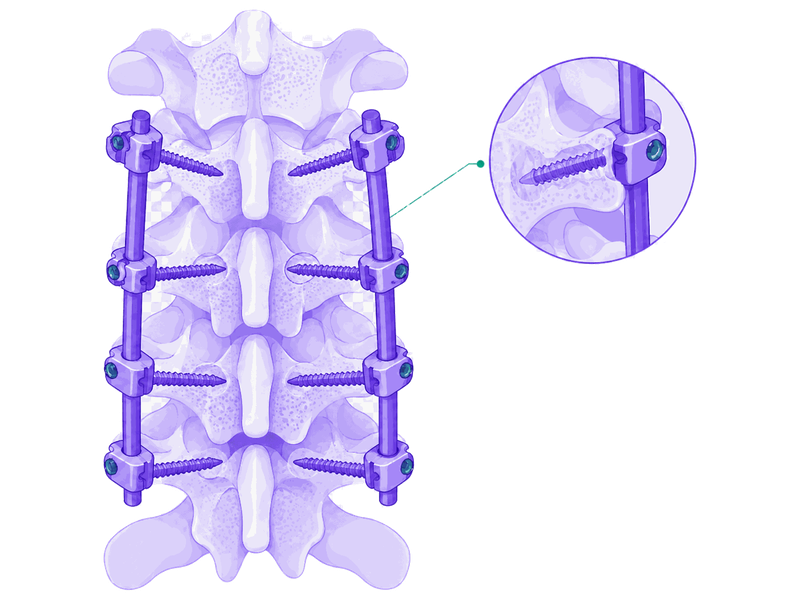
Fusion removes the excess movement. Screws placed into the vertebral bodies and the rods connecting them hold the segment in the correct position. Over time the vertebrae grow together into a single block - hence the name.
A fused segment loses its mobility. That is a deliberate price: a motionless segment does not hurt, and the neighbouring ones take over its work.
Who it is for
- Spondylolisthesis - a slipped vertebra that is progressing on the scans or causing leg pain.
- Instability after a vertebral fracture, when the vertebral body has lost its load-bearing capacity.
- Repeat operations at the same level, especially with scarring.
- Marked stenosis with deformity, when decompression alone is not enough and the narrowing cannot be removed without losing stability.
- Destruction of a vertebra by infection or a tumour.
- Pain that changes with position: bearable lying down, worse standing and walking - a typical sign of an unstable segment.
Contraindications
- Active infection, including at the operative site.
- Severe osteoporosis - screws do not hold in weak bone. This needs separate assessment and preparation.
- Uncontrolled heart or lung disease, clotting disorders that cannot be corrected.
- Uncontrolled diabetes.
If stability is preserved, the segment does not need fixation - decompression or microsurgery is enough. Fusion is discussed when movement in the segment has itself become the source of pain.
How it goes
- 1 Preparation Full work-up, consultation with a physician and an anaesthetist, and densitometry if osteoporosis is suspected.
- 2 Anaesthesia General.
- 3 Approach Depends on the level and the task: open, or through minimally invasive ports where the anatomy allows.
- 4 Placing the construct Screws are inserted into the vertebral bodies under X-ray guidance and connected with rods. If needed, decompression - freeing the compressed nerve - is done at the same time.
- 5 Closing The position of the construct is checked and the wound is closed. The operation takes from two to six hours.
- 6 Right after The first day under observation; we start getting patients up early, usually the next day.
Anaesthesia
General anaesthesia. The operation is long, so the anaesthetist's assessment here is particularly thorough: heart, lungs, vessels, blood clotting. If something needs correcting, the operation is postponed and the figures are put right first - that is normal practice, not a refusal.
During surgery the position of the screws is checked by X-ray, and afterwards pain relief continues on the ward: the first twenty-four hours are the most sensitive. More on anaesthesia in the article Anaesthesia for spinal surgery.
Recovery
- days 1–2
- getting up, first steps
- days 5–14
- hospital stay
- 1–2 weeks
- movement becomes noticeably more comfortable
- 6 weeks
- load restrictions still apply
- 3–6 months
- the bone block forms, return to normal life
Risks and possible complications
- Load on the neighbouring segments. The fused level does not move, so its neighbours take over its work - over time they wear out faster.
- Failure of the bone block to fuse.
- Loosening or displacement of screws, more often in bone of low density.
- Wound infection - the risk is higher than in small procedures because of the implant.
- Blood loss during a long procedure.
- Injury to a nerve root - rare.
Alternatives
- Decompression without fixation. When stability is preserved and the nerve only needs to be freed. Smaller operation, shorter recovery.
- Minimally invasive surgery. A smaller incision where the anatomy justifies it: less muscle trauma, a shorter stay.
- Vertebroplasty. For a fresh fracture without instability - it strengthens the vertebral body without screws.
- Conservative treatment and a brace. For a small slip with no nerve compression and no progression on the scans.
The decision to fuse is made from flexion and extension X-rays: what the segment does in movement matters, not only the static picture.
Where to start
The decision to fuse is made from the scans, not from the complaints: we need to see whether there is instability. Bring an MRI and flexion-extension X-rays, plus discharge summaries from previous treatment and operations, if there were any.
Bring the scans on a disc or a flash drive - I look at the images themselves, not the report: what to bring and on what.
I operate in Zaporizhzhia, at the City Hospital of Emergency and Ambulance Care. Call - I will tell you which examinations you need.
Questions about the operation
Will my spine become rigid?
Only the fused segment becomes rigid, and that is usually one or two out of twenty-four. In everyday movement it is barely noticeable: bending and turning are shared across the whole spine.
Will the implants have to be removed?
No, the construct stays for good. It is removed only rarely and for specific reasons - infection or displacement, for example.
Will the metal set off airport scanners?
As a rule, no: modern titanium constructs usually do not set off metal detectors. It is still worth carrying a note about the operation.
Can I have an MRI after implants are placed?
Yes, titanium constructs are MRI-compatible. Tell the radiologist about the operation.
Why is the hospital stay so long?
The procedure is larger than a microdiscectomy, and the first days are needed for monitoring and early mobilisation under supervision. The rehabilitation department is in the same hospital, so there is no need to transfer anywhere else.
Book a visit
Mon-Fri 08:30-15:00. On operating days I cannot answer the phone: message the same number instead.
+380 67 901 37 01Conditions this is used for
Conditions where this method is part of the treatment plan. Each page explains when surgery can be avoided and when it cannot wait.

Dmytro Ivakhnenko - spine neurosurgeon in Zaporizhzhia
Spine neurosurgeon of the highest category, PhD in Medicine, associate professor, 30 years in practice. Spine and nerve surgery in Zaporizhzhia.