Treatment and surgery for carpal tunnel syndrome in Zaporizhzhia
The median nerve is compressed in a narrow tunnel at the wrist. The fingers go numb at night, the hand "falls asleep" so badly that you get up and shake it out, and the pinch grip weakens - a cup slips, a button is hard to fasten, a key hard to turn. The thumb, index and middle fingers go numb; the little finger stays normal.
One of the few conditions where surgery gives a fast and predictable result.
- Symptoms
- fingers numb at night, the hand "falling asleep", a weak grip
- Work-up
- nerve conduction study of the hands, wrist ultrasound if needed
- Without surgery
- numbness only in episodes, muscles keep their strength, a splint helps
- Surgery
- minimally invasive decompression of the nerve
- Consultations
- room 211, Mon-Fri 08:30-15:00
True emergencies here are rare, but there are signs that must not be put off:
- The numbness has become constant, with no clear intervals left.
- The muscle at the base of the thumb is wasting - the mound is flat compared with the other hand.
- You cannot hold small objects, you drop a cup, you cannot do up a button.
These are signs that the nerve has been suffering for a long time. The longer that goes on, the worse it recovers after surgery - and here time works against you.
What carpal tunnel syndrome is
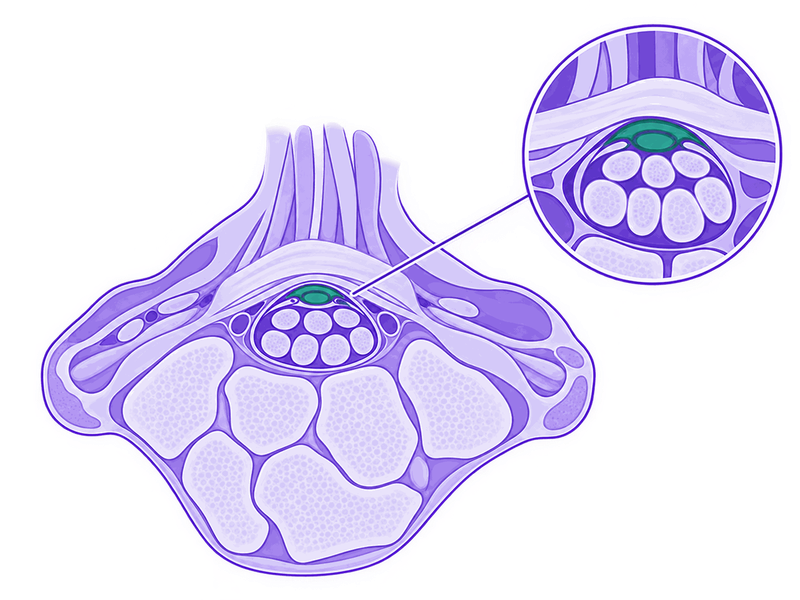
At the wrist, the tendons and the median nerve pass through a narrow tunnel bounded by bone and a dense transverse ligament. There is little room there to begin with.
When the contents of the tunnel swell - from repetitive load, hormonal change or inflammation of the tendon sheaths - the pressure inside rises and the nerve is the first to suffer. It supplies sensation to the thumb, index, middle and half the ring finger, and the muscles that move the thumb.
Hence the recognisable picture: exactly those fingers go numb while the little finger stays normal. And it is worse at night than by day, because in sleep the hand bends involuntarily and drainage from the tunnel worsens.
Symptoms
- Numbness and tingling in the thumb, index and middle fingers. The little finger does not go numb.
- Waking at night from numbness, wanting to shake the hand or let it hang.
- In the morning the hand feels foreign and needs loosening up.
- The pinch grip weakens: holding a key, doing up a button or opening a jar becomes harder.
- You drop small objects.
- In advanced cases, flattening of the mound at the base of the thumb.
- The pain can radiate up the forearm, sometimes to the shoulder.
Causes
Repetitive load on the hand - working with tools, with vibration, long hours at a keyboard and mouse in an awkward position.
Hormonal and systemic conditions: pregnancy, hypothyroidism, diabetes, rheumatoid arthritis. The after-effects of a wrist fracture or injury that narrow the tunnel.
In some people the tunnel is naturally narrow - then symptoms appear earlier and under less load.
How we diagnose it
A nerve conduction study of the hands is the main investigation. It shows exactly where and how far conduction is impaired and distinguishes carpal tunnel syndrome from a problem at the neck or the elbow. Without it the diagnosis remains a guess.
A wrist ultrasound is added when the structure needs to be seen: thickening of the nerve, a mass, the after-effects of injury.
An MRI of the neck if the picture is atypical. Numbness in the hand can also come from a cervical disc herniation, and sometimes both problems exist at once.
At the examination simple tests are used: bending the wrist, tapping over the tunnel, the strength of thumb opposition.
The nerve conduction study of the hands if it has been done, and the wrist ultrasound results. If the neck was scanned, bring those images too. If you have no investigations at all, I will tell you where to start when you book.
Bring the scans on a disc or a flash drive - I look at the images themselves, not the report: what to bring and on what.
If the nerve conduction study has not been done yet, say so when booking: I will tell you where to have it in Zaporizhzhia so that you come with the result.
How we treat it
A night splint
Changing the load
An injection into the tunnel
Surgery - decompression of the nerve
Indications for surgery
- The numbness has become constant.
- Weakness has appeared and the muscle at the base of the thumb is wasting.
- The nerve conduction study shows marked impairment.
- Several months of conservative treatment have not helped.
Timing matters here: a nerve compressed for years does not recover fully. An operation done in time gives the hand back almost always; done late, it removes the pain but not all of the strength.
Night-time numbness usually goes in the first days after the operation - the fastest effect of anything we do. The sutures come out after about two weeks. Full use of the hand after four to six weeks.
Strength returns more slowly than sensation, especially if the muscle has already started to waste. Rehabilitation helps there, but full recovery is not guaranteed.
Questions
Why does it go numb specifically at night?
In sleep the hand bends involuntarily, fluid drains from the tunnel less well and the pressure on the nerve rises. That is why a night splint holding the wrist straight often helps.
Is it from the computer?
Not only, and not always. Repetitive load is one factor but not the only one: hormonal conditions, diabetes, wrist injuries and a naturally narrow tunnel all matter.
Could it be coming from my neck?
Yes, and that is a common mistake. A cervical herniation also causes numbness in the hand. A nerve conduction study tells them apart. Sometimes both problems are present - then the one causing the main symptoms is treated first.
Is it a big operation?
No. It is a short procedure, often under local anaesthesia, through a small incision. Home usually the same or the next day.
Can both hands be operated on at once?
Usually not: one hand has to stay usable so that you can look after yourself. The second is operated on a few weeks later.
Call me and I will tell you what to do next
Mon-Fri 08:30-15:00. On operating days I cannot answer the phone: message the same number instead.
+380 67 901 37 01How it is treated
Procedures used for this condition. Each page covers how it goes, who it suits and how long recovery takes.

Dmytro Ivakhnenko - spine neurosurgeon in Zaporizhzhia
Spine neurosurgeon of the highest category, PhD in Medicine, associate professor, 30 years in practice. Spine and nerve surgery in Zaporizhzhia.