Treatment of lower back and neck pain in facet syndrome in Zaporizhzhia
The source of the pain is the small joints between the vertebrae, the facet joints. It hurts in the lower back or the neck itself on extension and on twisting, in the morning you need to "walk it off", and by evening after a load it gets worse. The pain is local, sometimes reaching the buttock or the thigh, but not below the knee.
It does not radiate below the knee and does not weaken the foot - that is the main difference from a herniated disc.
- Symptoms
- local low back pain on extension and turning
- Work-up
- MRI or CT of the lumbar spine, records of previous blocks
- Without surgery
- almost always: blocks, denervation, physical therapy
- Surgery
- not required; percutaneous techniques are used
- Consultations
- room 211, Mon-Fri 08:30-15:00
Facet syndrome in itself is not dangerous. But if something from this list joins the familiar pain, the picture is different:
- The pain has started radiating into the leg below the knee, with numbness.
- Weakness in the foot.
- Disturbed urination - call 103 (ambulance).
- Pain at night at rest, fever, weight loss.
What facet syndrome is
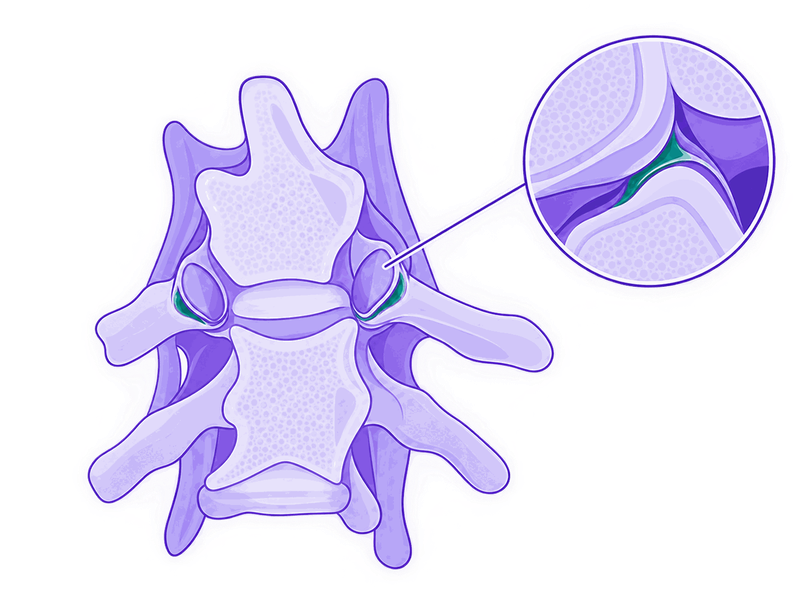
Each pair of neighbouring vertebrae is joined not only by a disc at the front but by two small joints at the back - the facet joints. They guide movement and carry part of the load, especially in extension.
Like any joint, a facet joint wears out: the cartilage thins, the capsule becomes inflamed, bone builds up at the edges. It is the same process as in a knee or a hip, only here it stays invisible.
A thin nerve branch runs to each such joint and carries nothing but pain. The treatment is built on exactly that: the branch can be switched off temporarily without touching either the joint or movement.
Facet syndrome is one of the most common causes of chronic low back pain after forty, and one of the most underdiagnosed: it is regularly mistaken for "degenerative disc disease" and treated with ointments for years.
Symptoms
- Local low back pain, usually on one side, sometimes radiating into the buttock and thigh - but not below the knee.
- Worse on bending backwards and on turning the trunk.
- Morning stiffness that takes fifteen to twenty minutes to "walk off".
- Standing for long is hard; leaning forward and sitting bring relief.
- The pain grows towards the end of the day and after static loading.
- There is no numbness and no weakness - that is essential.
Causes
Age-related wear of the joints is the main cause. It is accelerated by overload, work standing or bent over, excess weight, past injuries, and by instability or a slipped vertebra that makes the joints work the wrong way.
After disc surgery the load on the facet joints of that level increases, so facet syndrome sometimes develops after a herniation has been treated successfully.
How we diagnose it
The examination matters more than the scan. The diagnosis is made from the character of the pain: local, worse on extension and rotation, not going below the knee, with no neurological deficit.
An MRI or CT shows the state of the joints - arthritis, overgrowth, inflammation of the capsule. But almost everyone over forty has changes on a scan, and on their own they do not make the diagnosis.
A diagnostic block is the most reliable method. If the pain goes after medication is injected into a particular joint, the source has been found. That is both confirmation of the diagnosis and the selection criterion for denervation.
An MRI or CT of the lumbar spine and the records of any previous blocks: which ones, when and how much they helped. That matters more than a fresh scan.
Bring the scans on a disc or a flash drive - I look at the images themselves, not the report: what to bring and on what.
Come to Zaporizhzhia, 80 Peremohy St: the City Hospital of Emergency and Ambulance Care, 2nd floor, room 211.
How we treat it
Medication
Physical therapy
Nerve block
Radiofrequency denervation
Ablation
When surgery is needed
Open surgery is not performed for facet syndrome. Surgery enters the picture only if another problem has joined it - instability of the segment or canal stenosis.
If you are offered an operation for isolated facet joint pain, ask what exactly is to be operated on, and why.
After a block, relief usually comes within a few hours and lasts from weeks to months.
After denervation the effect develops over two to four weeks - not at once, and that is worth knowing in advance. After that it lasts for months, in some patients for years. The nerve branch regenerates in time and the procedure can be repeated.
None of these methods works without physical therapy. Without it you will be back in six months.
Questions
Is this the same as "degenerative disc disease"?
No. "Osteochondrosis" - the term usually translated as degenerative disc disease - is a word post-Soviet medicine applies to almost any back pain, and therefore it explains nothing. Facet syndrome is a specific diagnosis with a specific source of pain and a specific treatment.
Why does it only hurt on extension?
In extension the load shifts precisely onto the facet joints. Leaning forward moves it onto the discs and unloads the joint - hence the relief.
Is denervation permanent?
No. The branch regenerates within months or years and the pain can return. The procedure can be repeated.
Why a block first rather than denervation straight away?
A block shows whether the pain really comes from the facet joints. If it brings relief, denervation will work. If it does not, the source is elsewhere and denervation will be useless.
Can I do sport?
You should. The question is which kind: swimming, walking, core strengthening - yes; axial loading, jumping, sharp twisting - no.
Call me and I will tell you what to do next
Mon-Fri 08:30-15:00. On operating days I cannot answer the phone: message the same number instead.
+380 67 901 37 01How it is treated
Procedures used for this condition. Each page covers how it goes, who it suits and how long recovery takes.

Dmytro Ivakhnenko - spine neurosurgeon in Zaporizhzhia
Spine neurosurgeon of the highest category, PhD in Medicine, associate professor, 30 years in practice. Spine and nerve surgery in Zaporizhzhia.