Treatment of a herniated intervertebral disc in Zaporizhzhia
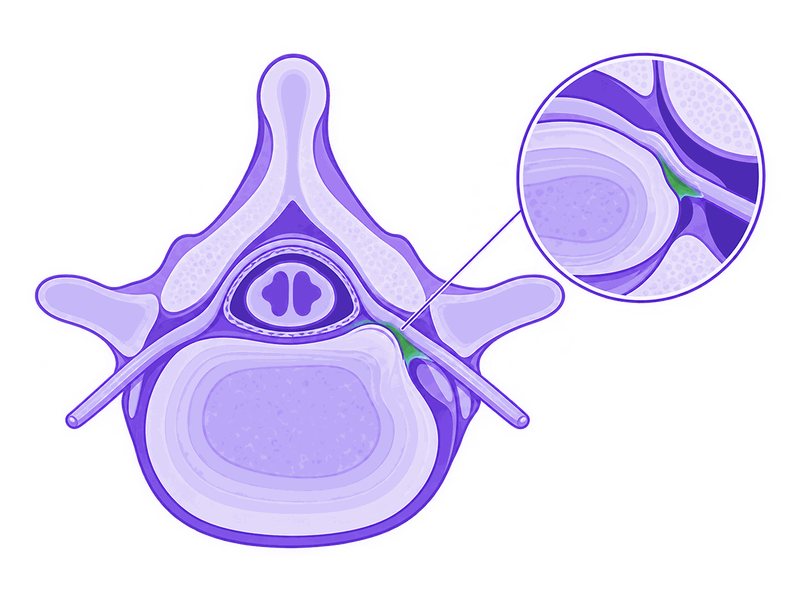
Part of the disc pushes out beyond the edge of the vertebrae and presses on a nerve root. The pain radiates into the leg or the arm, below the knee or as far as the toes, and with it come numbness, pins and needles and weakness - standing on tiptoe is hard, the foot gives way, small objects slip from the hand.
In most cases a herniated disc is treated without surgery. That is the first thing to know before being frightened by a scan.
- Symptoms
- pain in the leg or arm, numbness, a weak foot
- Work-up
- MRI of the relevant part; which one, I will say when you book
- Without surgery
- most cases, 4–6 weeks of treatment
- Surgery
- microdiscectomy, about 3 days in hospital
- Consultations
- room 211, Mon-Fri 08:30-15:00
These are the cases where you must not wait for an appointment:
- Disturbed urination or bowel control - you cannot pass urine, or conversely cannot hold it. Call 103 (ambulance).
- Numbness in the groin and the inner thighs - "saddle" loss of sensation. Same signal, call 103 (ambulance).
- Increasing weakness in the foot - the leg gives way, you cannot stand on your toes or your heel. See a doctor today, do not wait for an appointment.
- Sudden weakness in the hand, the hand cannot hold objects.
- Pain after an injury - a fall, a traffic accident, a blow.
If none of that applies, the situation is not an emergency and you have time to get the scans and book calmly.
What a herniated disc is
Between the vertebrae lie discs - dense cushions that absorb load when you walk, bend or pick up a bag. Each disc is built like a cushion: a strong outer ring with a soft nucleus inside.
With age and load the ring weakens and tears. The nucleus starts pushing outwards - at first the ring simply bulges (that is a protrusion), then part of the contents escapes beyond it (that is a herniation). If the bulge lies in the path of a nerve root, the root is compressed and inflamed.
The back pain itself can be mild. What the person mainly feels is pain along the nerve: from the lower back down the back of the leg, below the knee, sometimes to the toes. With a herniation in the neck it is the same, but in the arm.
Symptoms
- Pain radiating into the leg below the knee or into the arm down to the fingers - often stronger than in the back itself.
- Numbness or pins and needles along a particular strip of skin.
- Weakness: the foot lifts poorly, the leg gives way, the hand grips less well.
- The pain is worse on coughing, sneezing and straining.
- Sitting for long is harder than standing or walking.
- A sudden "shot" while lifting something heavy or on a sharp movement - and the leg has been pulling ever since.
Causes
A herniation is not the result of a single awkward movement, though that is often the last straw. The disc wears out over years: with age it loses water and elasticity, and the outer ring becomes brittle.
The process is accelerated by sedentary work without movement, prolonged vibration, smoking (which impairs the disc's nutrition), excess weight and weak back muscles. There is also a hereditary predisposition.
Nobody is to blame for having a herniation. The claim that "you lifted incorrectly" describes the occasion, not the cause.
How we diagnose it
An MRI is needed. X-rays do not show discs, and CT sees soft tissue less well. The requirements are simple: a 1.5 Tesla machine or better, and scans no more than six months old.
Which part to scan: pain and numbness in the leg - lumbar. Pain and numbness in the arm - cervical. If you are unsure, I will tell you over the phone when you book.
One more point: a finding on an MRI and the source of pain are not always the same. Herniations are found in people with no pain at all. So we look not only at the scan but at whether it matches your symptoms and what the examination shows.
The scans themselves on a disc or a flash drive, not a photograph of a screen; the report; discharge summaries from previous treatment; a list of the medicines you take regularly.
I look at the images themselves, not the report: what to bring and on what.
I see patients in Zaporizhzhia, room 211 of the City Hospital of Emergency and Ambulance Care at 80 Peremohy St.
How we treat it
The order is always the same: from the simple to the complex.
Medication and activity modification
Physical therapy and rehabilitation
Nerve block
Surgery
Indications for surgery
- Pain in the leg or arm persisting longer than six weeks under adequate treatment.
- Increasing weakness in the limb.
- Disturbed bladder or bowel function - we operate urgently.
- Flare-ups recurring several times a year and knocking you out of work.
- The herniation on the MRI matches where it hurts.
Some herniations, especially large sequestrated fragments, shrink on their own over time: the body gradually clears them. That can be relied on only when there is no weakness in the limb and the pain is under control. We check with a repeat examination, not with a single scan.
After a herniation is removed you can usually do office work within a week, while limiting the load on the spine. Driving after roughly two weeks. Full physical activity after six weeks. Numbness fades more slowly than pain: if the root was compressed for a long time, sensation can take months to return.
Week by week in the article Recovery after surgery.
Questions
Can a herniated disc be treated without surgery?
In most cases yes. The pain subsides over four to six weeks with medication, load management and physical therapy; some herniations shrink on their own. Surgery is needed when the nerve is persistently compressed or weakness has appeared in a limb.
Will the herniation resolve on its own?
Some herniations - especially large sequestrated fragments - do shrink over several months. But you can count on that only if there is no weakness and the pain is controlled.
Will massage or spinal traction help?
During a flare-up with leg pain, aggressive manual techniques and traction can make things worse. Once the acute phase is over, manual therapy and massage of the back muscles have their place as part of rehabilitation. The order matters more than the method.
Will the herniation come back after surgery?
Recurrence at the same level happens in a small proportion of patients. The risk is reduced by respecting the load restrictions in the first weeks, strengthening the core muscles and giving up smoking. If leg pain returns after the operation, what is needed is a repeat MRI, not waiting.
How long is the wait for a consultation?
Booking is by phone, usually for the next working days. If surgery is already on the table, say so during the call - you will be seen without queueing.
Call me and I will tell you what to do next
Mon-Fri 08:30-15:00. On operating days I cannot answer the phone: message the same number instead.
+380 67 901 37 01How it is treated
Procedures used for this condition. Each page covers how it goes, who it suits and how long recovery takes.

Dmytro Ivakhnenko - spine neurosurgeon in Zaporizhzhia
Spine neurosurgeon of the highest category, PhD in Medicine, associate professor, 30 years in practice. Spine and nerve surgery in Zaporizhzhia.