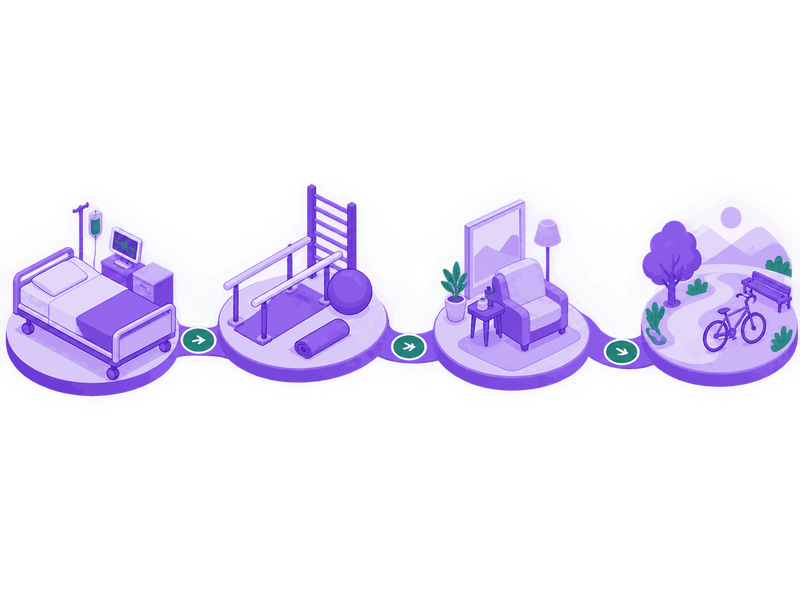
Week by week
- day 1
- getting up, first steps around the ward
- day 3
- discharge home
- 2–4 weeks
- the main recovery
- 6 weeks
- normal activity
- 6 months
- follow-up examination and MRI
The first three days: getting up and going home
We get patients up early, usually on the first day, and that is not bravado but treatment: early movement lowers the risk of thrombosis and pneumonia and speeds recovery.
The first time, only with a nurse. The technique is simple: roll onto your side, swing your legs off the bed, push up with your arms and sit up without bending your back. Lie down again the same way.
Pain at the wound in the first days is normal. Pain relief is prescribed and there is no need to endure it - say so if it is not working.
Right after the operation the pain the whole thing was done for usually disappears: if a root was compressed, the leg stops hurting. What remains in the first days is swelling around the root, and it passes.
The first six weeks: what is allowed and what is not
You can and should:
- Walk. A little every day, gradually increasing the distance. Walking is the main "exercise" of the first weeks.
- Climb stairs, calmly.
- Do ordinary household tasks that involve no bending or lifting.
- Lift more than three to five kilograms.
- Bend with straight legs. Squat down instead, keeping your back straight.
- Sit for long without a break. In the first weeks, no more than 20–30 minutes at a time, then get up and walk.
- Twist your body sharply, especially with weight in your hands.
- Run, jump or go to the gym.
- Use a sauna or take hot baths until the wound has healed.
- Lift more than three to five kilograms.
- Bend with straight legs. Squat down instead, keeping your back straight.
- Sit for long without a break. In the first weeks, no more than 20–30 minutes at a time, then get up and walk.
- Twist your body sharply, especially with weight in your hands.
- Run, jump or go to the gym.
- Use a sauna or take hot baths until the wound has healed.
A brace. Usually needed, but not around the clock and not for ever: it is worn under load, not lying down. Constant use weakens your own back muscles. You will be told the exact period at discharge.
The wound. Keep it dry until the sutures come out, usually about two weeks. You can wash with it covered by a dressing.
Driving, work, sport
| What | When it is usually allowed |
|---|---|
| Office work | after a week, with breaks |
| Driving | after 2 weeks |
| Physical work | after 6–8 weeks |
| Swimming | once the wound has healed, 3–4 weeks |
| The gym | after 3 months, with a trainer |
| Running, jumping, weightlifting | discussed individually |
| Flying | after 2–3 weeks |
| Sex | after 2–4 weeks |
You can drive provided you are not taking painkillers that affect your reactions and that you can turn your body freely to look behind you. Keep the first trips short.
When to call the same day
- Increasing weakness in the leg or arm.
- Disturbed urination or bowel control.
- A sharp increase in pain that the prescribed drugs do not control.
- The wound is red, swollen or discharging.
- A temperature above 38 °C.
- Swelling and pain in the calf - a possible sign of thrombosis.
None of these is a reason to panic, but each is a reason to call the same day rather than wait for the scheduled visit.
Rehabilitation: when to start
For the first two or three weeks no special exercises are needed: walking is the main activity.
From the third or fourth week physical therapy is added: strengthening the muscles that unload the spine. This is not optional and not "if there is time" - whether the pain comes back depends directly on it. Strong core muscles do what no operation can.
It is better to work with a rehabilitation specialist at least for the first sessions, to learn the technique. After that, on your own, regularly and for a long time.
What to avoid: aggressive manual therapy, traction, "putting vertebrae back", and intensive massage over the operated area in the first weeks.
What next
If recovery is not going as expected, or leg pain has come back, call and come in with a new scan. Waiting in that situation works against you.
